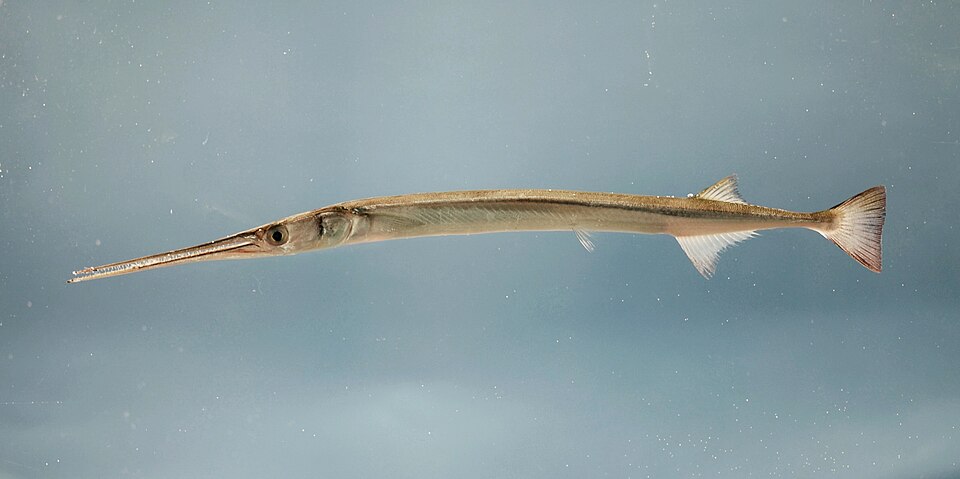

The Atlantic needlefish (Strongylura marina) is a common demersal needlefish species common in marinas and other areas with minimal currents. Body very elongated, rounded; extremely elongated jaws form a long beak, with numerous needle-like teeth; rear of the top jaw-bone by being exposed when the mouth is closed. It has no gill rakers, the fins without spines; low lobes at the front of the dorsal and anal fins. Its dorsal fin is composed of 14–17 rays, anal fins is composed of 16–20 rays, and pectorals 10–12. Atlantic needlefish are found from Maine to Brazil and have been known to venture into fresh water for short periods, water columns, estuary, and reef associated.
From Wikipedia, under CC BY-SA 4.0.
Is it venomous or poisonous?
We have no record of Atlantic Needlefish being toxic, poisonous or venomous. That is not proof that it is safe. Never eat, touch or handle a wild plant, mushroom or animal on the strength of an identification; ask someone qualified.
Easily confused with
- Strongylura timucu
- Strongylura notata
- Strongylura strongylura
- Strongylura exilis
- Belone belone
- Tylosurus gavialoides
Classification
- Kingdom
- Animalia
- Phylum
- Chordata
- Class
- Actinopterygii
- Order
- Beloniformes
- Family
- Belonidae
- Genus
- Strongylura
- Species
- Strongylura marina
Found one? Take a photo and B.inomen will suggest what it is, free.
Check your photo