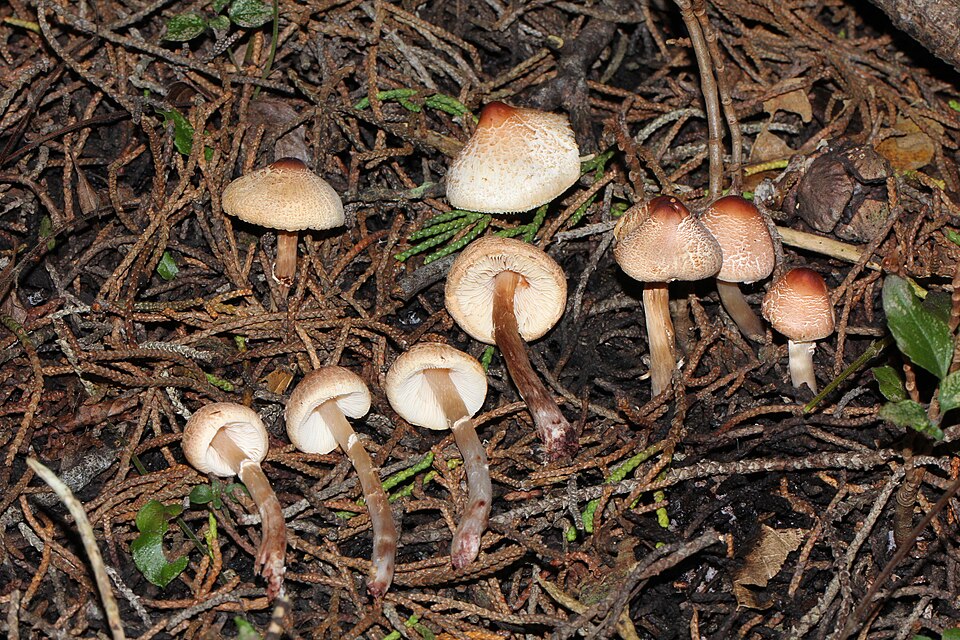

Lepiota castaneidisca is a species of agaric fungus in the family Agaricaceae. Formally described in 1912, it was for a long time considered the same species as the similar Lepiota cristata until molecular analysis reported in 2001 demonstrated that it was genetically distinct. It is most common in coastal and northern California, and has also been recorded in Mexico. A saprobic species, it is usually found under redwood and Monterey cypress. Its fruit bodies (mushrooms) have white caps with an orange-red to orange-brown center that measure up to 3.2 cm (1.3 in) wide. The cream-colored to light pink stems are up to 6.5 cm (2.6 in) long by 0.2–0.6 cm (0.1–0.2 in) thick, and have a ring. L.
From Wikipedia, under CC BY-SA 4.0.
Is it poisonous?
Considered toxic. Public sources list it as such; we have not verified this individually. The note covers its whole genus. Small dapperlings; several deadly amatoxin species Never eat, touch or handle a wild plant, mushroom or animal on the strength of an identification; ask someone qualified.
Easily confused with
- Leucoagaricus rubrotinctoides
- Lepiota cristata — considered toxic
- Lepiota spheniscispora — considered toxic
- Lepiota lilacea — considered toxic
- Leucocoprinus flammeotinctus
- Lepiota subincarnata — toxic
Classification
- Kingdom
- Fungi
- Phylum
- Basidiomycota
- Class
- Agaricomycetes
- Order
- Agaricales
- Family
- Verrucosporaceae
- Genus
- Lepiota
- Species
- Lepiota castaneidisca
Found one? Take a photo and B.inomen will suggest what it is, free.
Check your photo