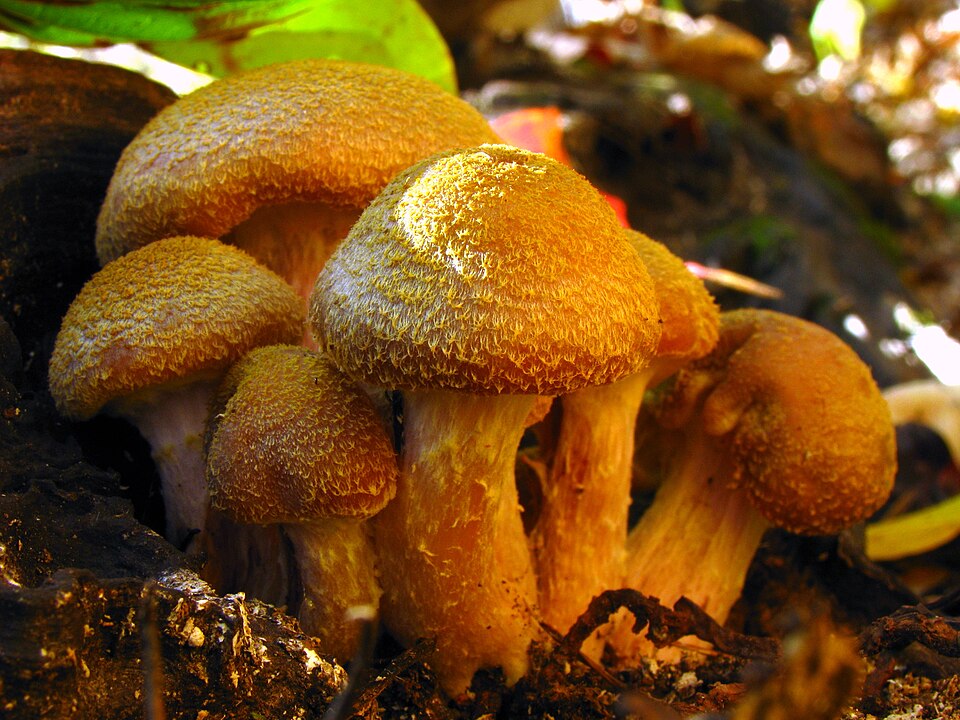

Armillaria gallica (synonymous with A. bulbosa and A. lutea) is a species of honey mushroom in the family Physalacriaceae of the order Agaricales. The species is a common and ecologically important wood-decay fungus that can live as a saprobe, or as an opportunistic parasite in weakened tree hosts to cause root or butt rot. It is found in temperate regions of Asia, North America, and Europe. The species forms fruit bodies singly or in groups in soil or rotting wood. The fungus has been inadvertently introduced to South Africa. Armillaria gallica has had a confusing taxonomy, due in part to historical difficulties encountered in distinguishing between similar Armillaria species.
From Wikipedia, under CC BY-SA 4.0.
Is it poisonous?
We have no record of Bulbous Honey Fungus being toxic, poisonous or venomous. That is not proof that it is safe. Never eat, touch or handle a wild plant, mushroom or animal on the strength of an identification; ask someone qualified.
Easily confused with
- Armillaria cepistipes
- Armillaria ostoyae
- Armillaria sinapina
- Armillaria solidipes
- Armillaria borealis
- Armillaria mellea
Classification
- Kingdom
- Fungi
- Phylum
- Basidiomycota
- Class
- Agaricomycetes
- Order
- Agaricales
- Family
- Physalacriaceae
- Genus
- Armillaria
- Species
- Armillaria gallica
Found one? Take a photo and B.inomen will suggest what it is, free.
Check your photo