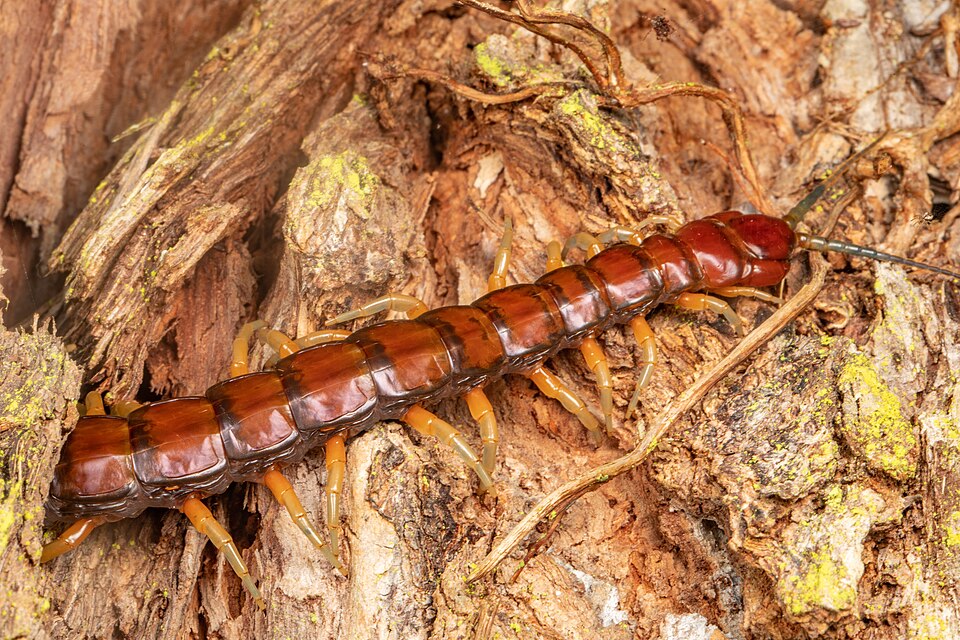

Cormocephalus rubriceps, commonly known as hura or giant centipede, is a species of centipede that can reach up to 20 centimetres (8 in) in length. They are native to Australia and New Zealand. In Australia, they occur in several pockets throughout the country whilst in New Zealand they occur only in the North Island. It was first described in 1843 by English entomologist George Newport. They typically occur in damp habitat such as rotting logs, but occasionally occur in caves. They are predators that will feed on a range of invertebrates and small reptiles. When threatened, they can inflict a painful bite.
From Wikipedia, under CC BY-SA 4.0.
Is it venomous or poisonous?
We have no record of New Zealand giant centipede being toxic, poisonous or venomous. That is not proof that it is safe. Never eat, touch or handle a wild plant, mushroom or animal on the strength of an identification; ask someone qualified.
Easily confused with
- Scolopendra alternans — venomous
- Ethmostigmus rubripes
- Scolopendra valida — venomous
- Scolopendra viridicornis — venomous
- Cormocephalus aurantiipes
- Otostigmus scaber
Classification
- Kingdom
- Animalia
- Phylum
- Arthropoda
- Class
- Chilopoda
- Order
- Scolopendromorpha
- Family
- Scolopendridae
- Genus
- Cormocephalus
- Species
- Cormocephalus rubriceps
Found one? Take a photo and B.inomen will suggest what it is, free.
Check your photo