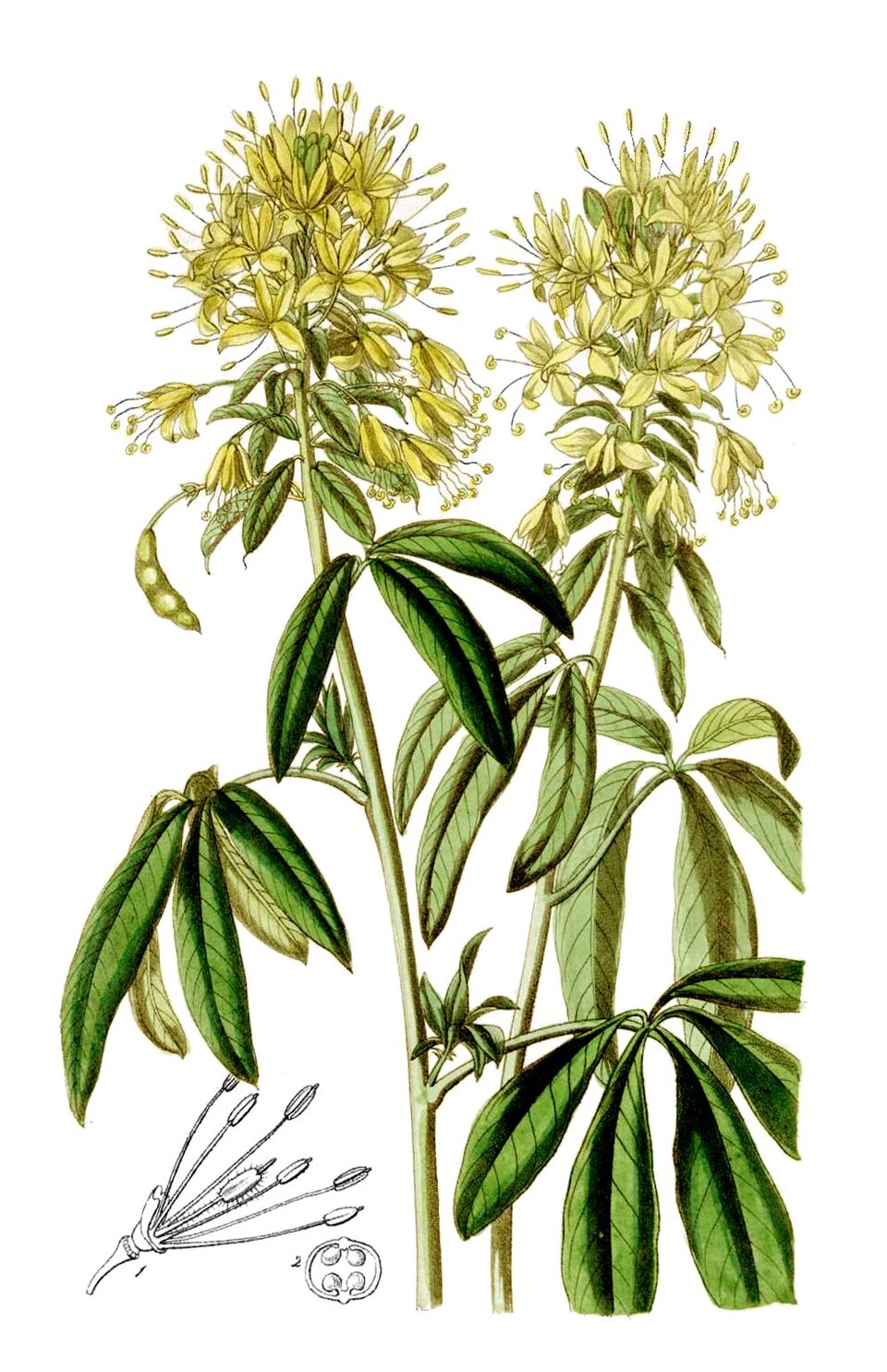

Cleomella lutea is a species of flowering plant known by the common names yellow bee plant and yellow spiderflower. This annual wildflower is native to the western United States where it is most common in desert scrub and plateau habitats. It is a sprawling plant often exceeding 1 metre (3 feet) in height. The erect stem can be branched and has widely spaced leaves all the way along, each leaf made up of three to five leaflets, which are smaller closer to the top of the plant. Atop the stem is a showy inflorescence of many bright yellow flowers. Each flower has four narrow sepals and four oblong petals around a cluster of six long stamens tipped with knobby anthers.
From Wikipedia, under CC BY-SA 4.0.
Is it poisonous?
We have no record of Yellow beeplant being toxic, poisonous or venomous. That is not proof that it is safe. Never eat, touch or handle a wild plant, mushroom or animal on the strength of an identification; ask someone qualified.
Easily confused with
- Cleomella jonesii
- Cleomella longipes
- Cleomella plocasperma
- Cleomella palmeri
- Cleomella refracta
- Cleomella hillmanii
Classification
- Kingdom
- Plantae
- Phylum
- Tracheophyta
- Class
- Magnoliopsida
- Order
- Brassicales
- Family
- Cleomaceae
- Genus
- Cleomella
- Species
- Cleomella lutea
Found one? Take a photo and B.inomen will suggest what it is, free.
Check your photo