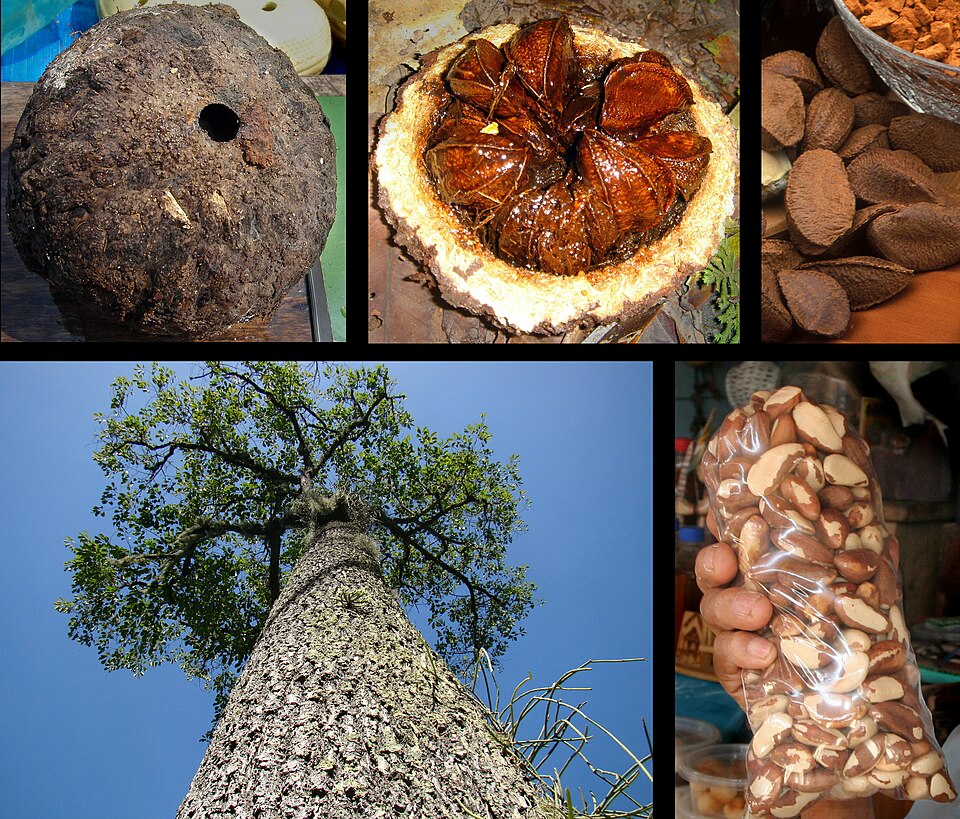

Brazil nut (Bertholletia excelsa) refers to a South American tree of the monotypic genus Bertholletia in the family Lecythidaceae as well as the tree's commercially-harvested edible seeds. It is one of the largest and longest-lived trees in the Amazon rainforest. The fruit and its nutshell – containing the edible nut – are relatively large and weigh as much as 2 kg (4.4 lb) in total. As food, Brazil nuts are notable for diverse content of micronutrients, especially a high amount of selenium. The wood of the Brazil nut tree is prized for its quality in carpentry, flooring, and heavy construction.
From Wikipedia, under CC BY-SA 4.0.
Is it poisonous?
We have no record of Brazil Nut being toxic, poisonous or venomous. That is not proof that it is safe. Never eat, touch or handle a wild plant, mushroom or animal on the strength of an identification; ask someone qualified.
Easily confused with
- Cariniana legalis
- Lecythis ampla
- Pterygota brasiliensis
- Khaya anthotheca
- Lecythis pisonis
- Aspidosperma megalocarpon
Classification
- Kingdom
- Plantae
- Phylum
- Tracheophyta
- Class
- Magnoliopsida
- Order
- Ericales
- Family
- Lecythidaceae
- Genus
- Bertholletia
- Species
- Bertholletia excelsa
Found one? Take a photo and B.inomen will suggest what it is, free.
Check your photo