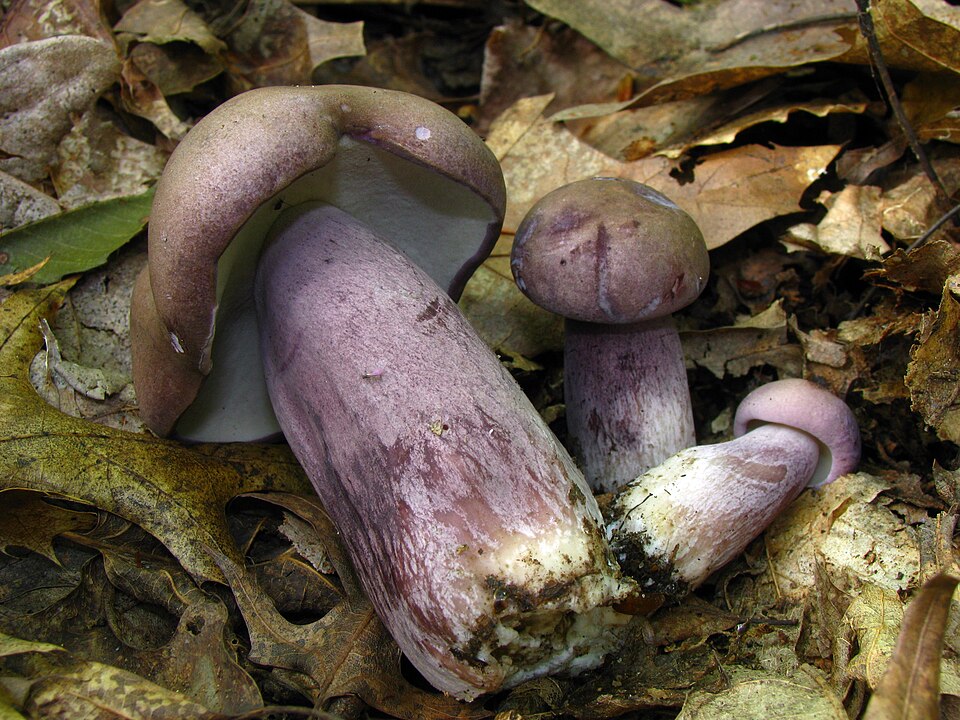

Tylopilus plumbeoviolaceus (formerly Boletus plumbeoviolaceus), commonly known as the violet-grey bolete, is a fungus of the bolete family. First described in 1936, the mushroom has a disjunct distribution, and is distributed in North America and Korea. The fruit bodies of the fungus are violet when young, but fade into a chocolate brown color when mature. They are solid and relatively large—cap diameter up to 15 cm (6 in), with a white pore surface that later turns pink, and a white mycelium at the base of the stem. The mushroom is inedible. A number of natural products have been identified from the fruit bodies, including unique chemical derivatives of ergosterol, a fungal sterol.
From Wikipedia, under CC BY-SA 4.0.
Is it poisonous?
We have no record of Violet Gray Bolete being toxic, poisonous or venomous. That is not proof that it is safe. Never eat, touch or handle a wild plant, mushroom or animal on the strength of an identification; ask someone qualified.
Easily confused with
Classification
- Kingdom
- Fungi
- Phylum
- Basidiomycota
- Class
- Agaricomycetes
- Order
- Boletales
- Family
- Boletaceae
- Genus
- Tylopilus
- Species
- Tylopilus plumbeoviolaceus
Found one? Take a photo and B.inomen will suggest what it is, free.
Check your photo