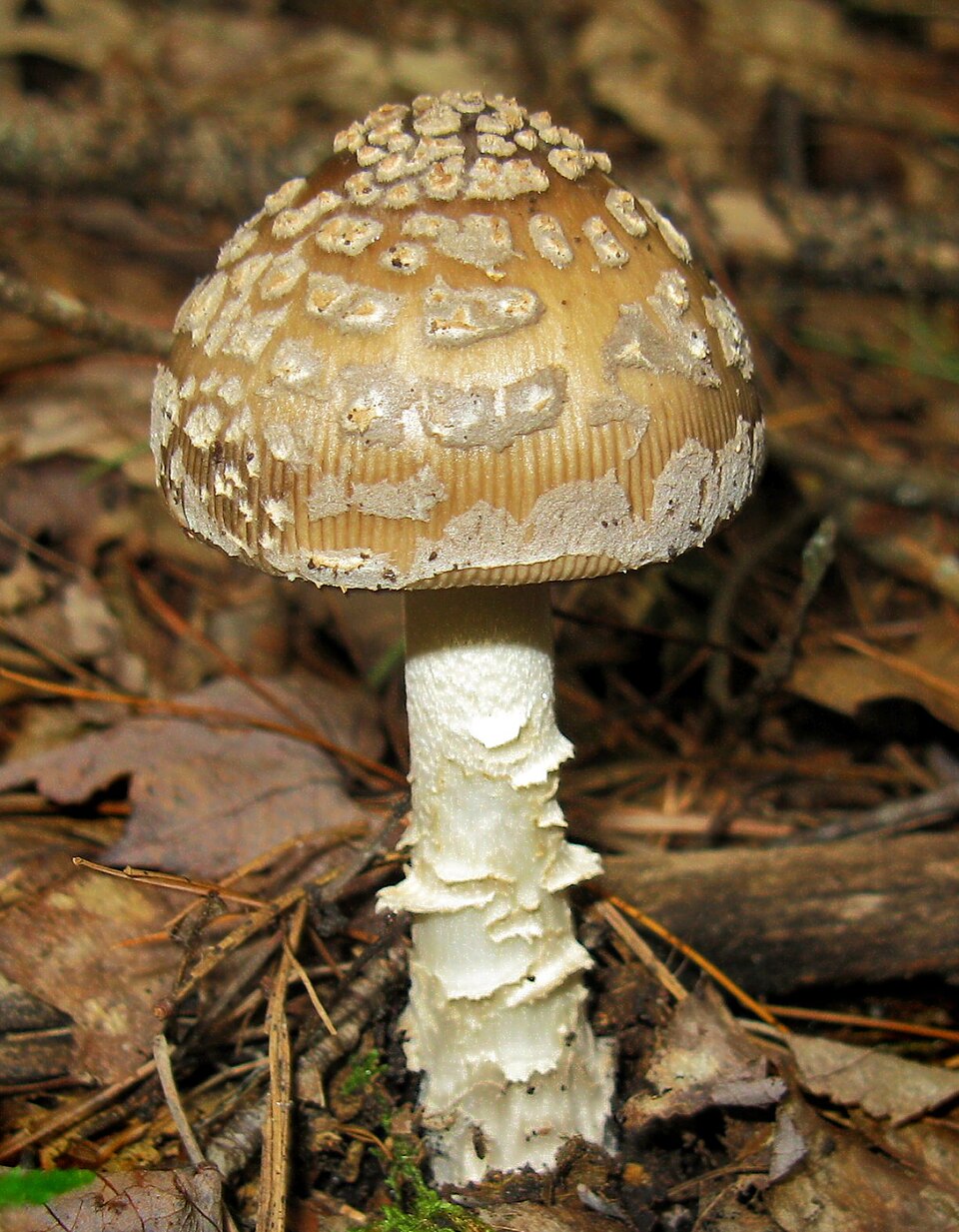

Amanita ceciliae, commonly called snakeskin grisette, strangulated amanita, and the Cecilia's ringless amanita, is a basidiomycete fungus in the genus Amanita. First described in 1854 by Miles Joseph Berkeley and Christopher Edmund Broome, it was given its current name by Cornelis Bas in 1984. It is characterized by bearing a large fruit body with a brown cap 5–12 cm (2.0–4.7 in) across. The cap has charcoal-grey patches, which are easily removable. The stipe is 7–18 cm (2.8–7.1 in) long, white in colour, and there is no ring on it. It is slightly tapered to the top and has irregular cottony bands girdling the base. The universal veil is grey.
From Wikipedia, under CC BY-SA 4.0.
Is it poisonous?
Considered toxic. Public sources list it as such; we have not verified this individually. The note covers its whole genus. Genus holds the deadliest mushrooms; several species are edible but none should be eaten without expert identification Never eat, touch or handle a wild plant, mushroom or animal on the strength of an identification; ask someone qualified.
Easily confused with
- Amanita rhacopus — considered toxic
- Amanita eliae — considered toxic
- Amanita submembranacea — considered toxic
- Amanita simulans — considered toxic
- Amanita lividopallescens — considered toxic
Classification
- Kingdom
- Fungi
- Phylum
- Basidiomycota
- Class
- Agaricomycetes
- Order
- Agaricales
- Family
- Amanitaceae
- Genus
- Amanita
- Species
- Amanita ceciliae
Found one? Take a photo and B.inomen will suggest what it is, free.
Check your photo