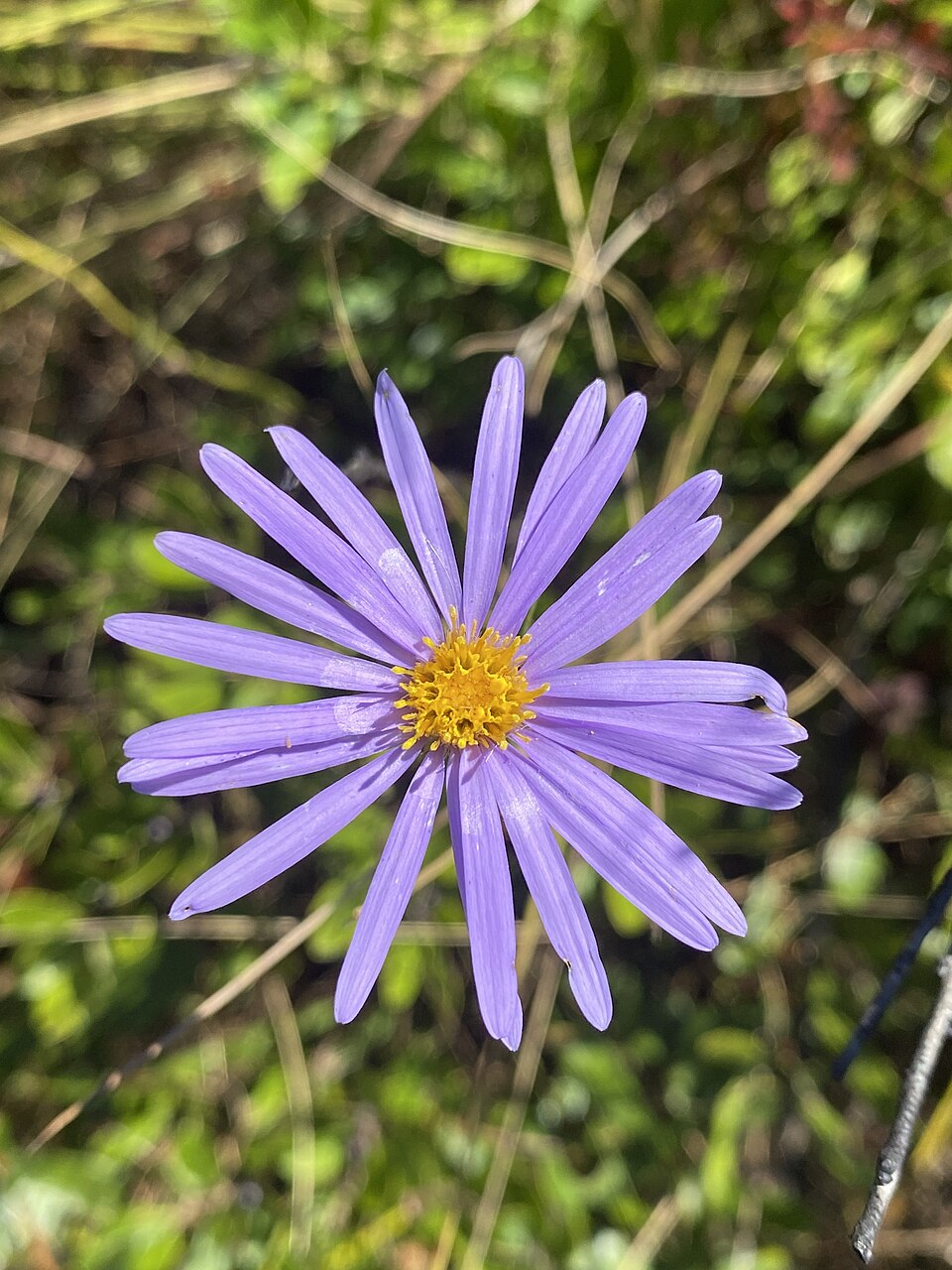

Eurybia paludosa, commonly known as the southern swamp aster or Savannah grass-leaved aster, is an herbaceous perennial in the family Asteraceae. It is native to the southeastern United States where it is confined to the Carolinas and the states of Georgia and Florida. It is generally confined to moist soils, though it can occasionally be found on sand hills along the coastal plain. The southern swamp aster is often confused with the closely related southern prairie aster (Eurybia hemispherica), though they do not occur in the same habitats or geographical areas. Its flower heads emerge in the late summer through fall and show deep lavender to purple rays with yellow centres.
From Wikipedia, under CC BY-SA 4.0.
Is it poisonous?
We have no record of Southern swamp aster being toxic, poisonous or venomous. That is not proof that it is safe. Never eat, touch or handle a wild plant, mushroom or animal on the strength of an identification; ask someone qualified.
Easily confused with
- Eurybia hemispherica
- Eurybia surculosa
- Eurybia spectabilis
- Symphyotrichum grandiflorum
- Symphyotrichum chapmanii
- Eurybia compacta
Classification
- Kingdom
- Plantae
- Phylum
- Tracheophyta
- Class
- Magnoliopsida
- Order
- Asterales
- Family
- Asteraceae
- Genus
- Eurybia
- Species
- Eurybia paludosa
Found one? Take a photo and B.inomen will suggest what it is, free.
Check your photo