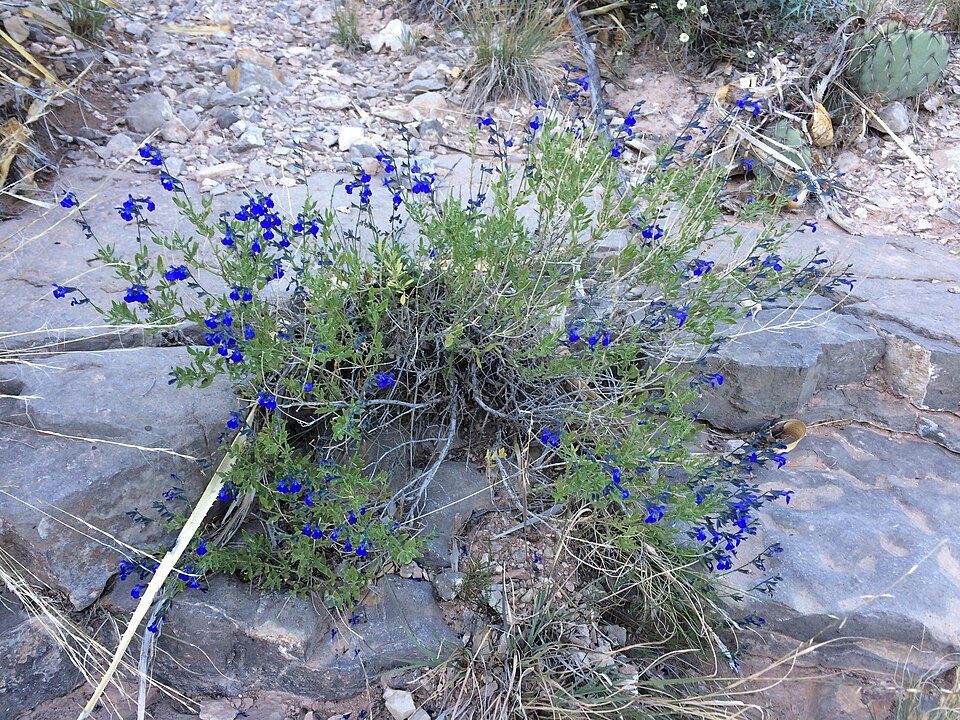

Salvia lycioides (Canyon sage) is a perennial native to a wide area ranging from west Texas and New Mexico in the U.S., south through Mexico to the state of San Luis Potosi. It typically grows on dry limestone hills and canyons above 5,000 feet elevation. It was named in 1886 by Asa Gray, the most respected American botanist of the 19th century. The specific epithet, "lycioides", from the Greek, is due to the plant's resemblance to Lycium, a genus also known as "boxthorn" in the nightshade family.
From Wikipedia, under CC BY-SA 4.0.
Is it poisonous?
We have no record of Canyon Sage being toxic, poisonous or venomous. That is not proof that it is safe. Never eat, touch or handle a wild plant, mushroom or animal on the strength of an identification; ask someone qualified.
Easily confused with
Classification
- Kingdom
- Plantae
- Phylum
- Tracheophyta
- Class
- Magnoliopsida
- Order
- Lamiales
- Family
- Lamiaceae
- Genus
- Salvia
- Species
- Salvia lycioides
Found one? Take a photo and B.inomen will suggest what it is, free.
Check your photo