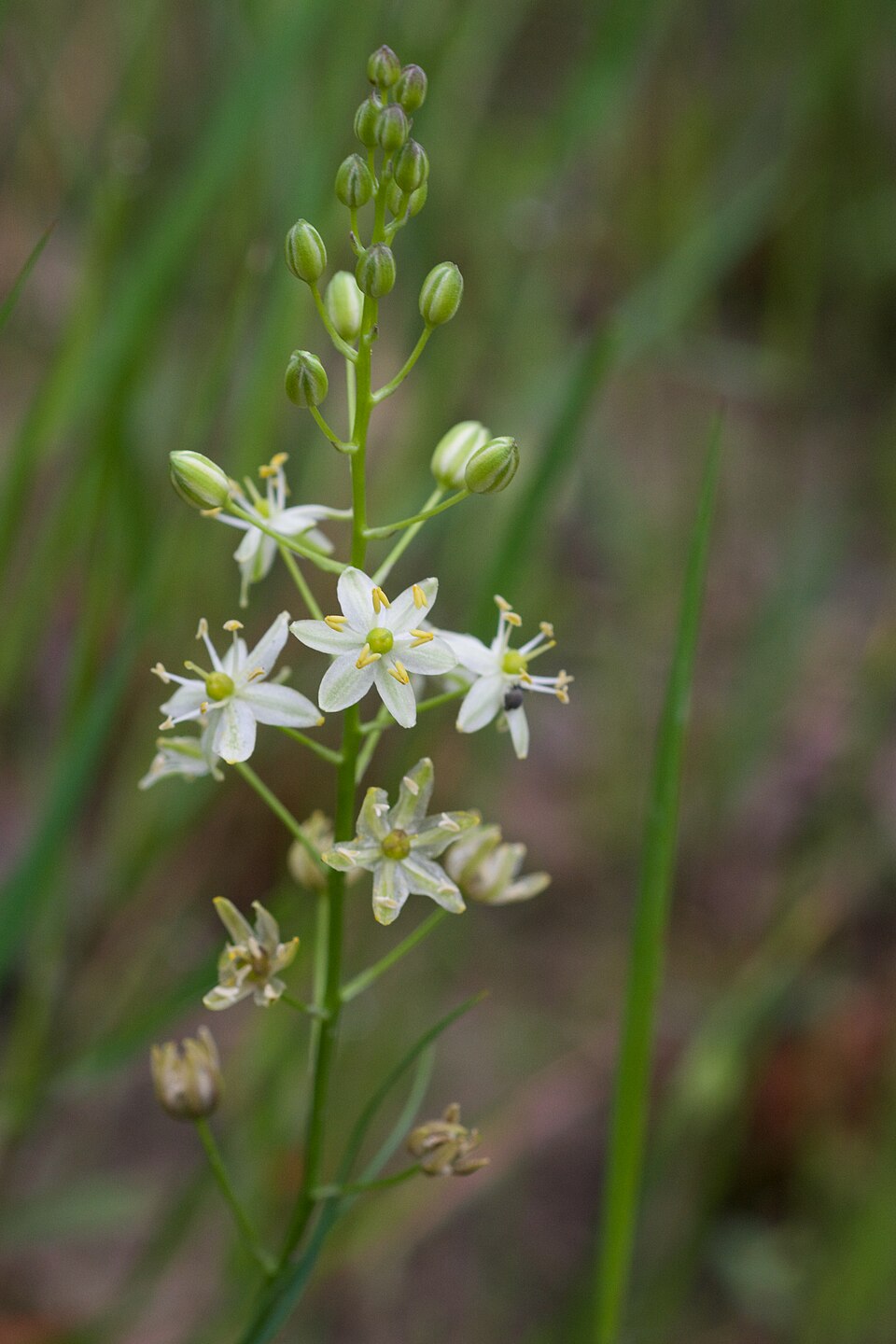

Schoenolirion wrightii, known as Texas sunnybell, is a species of flowering plant in the Agave subfamily. It is native to the southern United States, in Texas, Louisiana, Arkansas, and Alabama. Texas sunnybell produces vertical rootstocks topped with prominent bulbs, each up to 17 mm (0.67 in) in diameter. Between two and seven leaves are produced per plant, up to 34 cm (13 in) long and only 6 mm (0.24 in) across each, flattened to slightly keeled and usually shorter than the flowerhead. The ovate to lanceolate tepals are white with a green stripe on the back, mostly three-veined, but sometimes five-veined.
From Wikipedia, under CC BY-SA 4.0.
Is it poisonous?
We have no record of Texas Sunnybell being toxic, poisonous or venomous. That is not proof that it is safe. Never eat, touch or handle a wild plant, mushroom or animal on the strength of an identification; ask someone qualified.
Easily confused with
- Schoenolirion albiflorum
- Toxicoscordion micranthum — considered toxic
- Schoenolirion croceum
Classification
- Kingdom
- Plantae
- Phylum
- Tracheophyta
- Class
- Liliopsida
- Order
- Asparagales
- Family
- Asparagaceae
- Genus
- Schoenolirion
- Species
- Schoenolirion wrightii
Found one? Take a photo and B.inomen will suggest what it is, free.
Check your photo