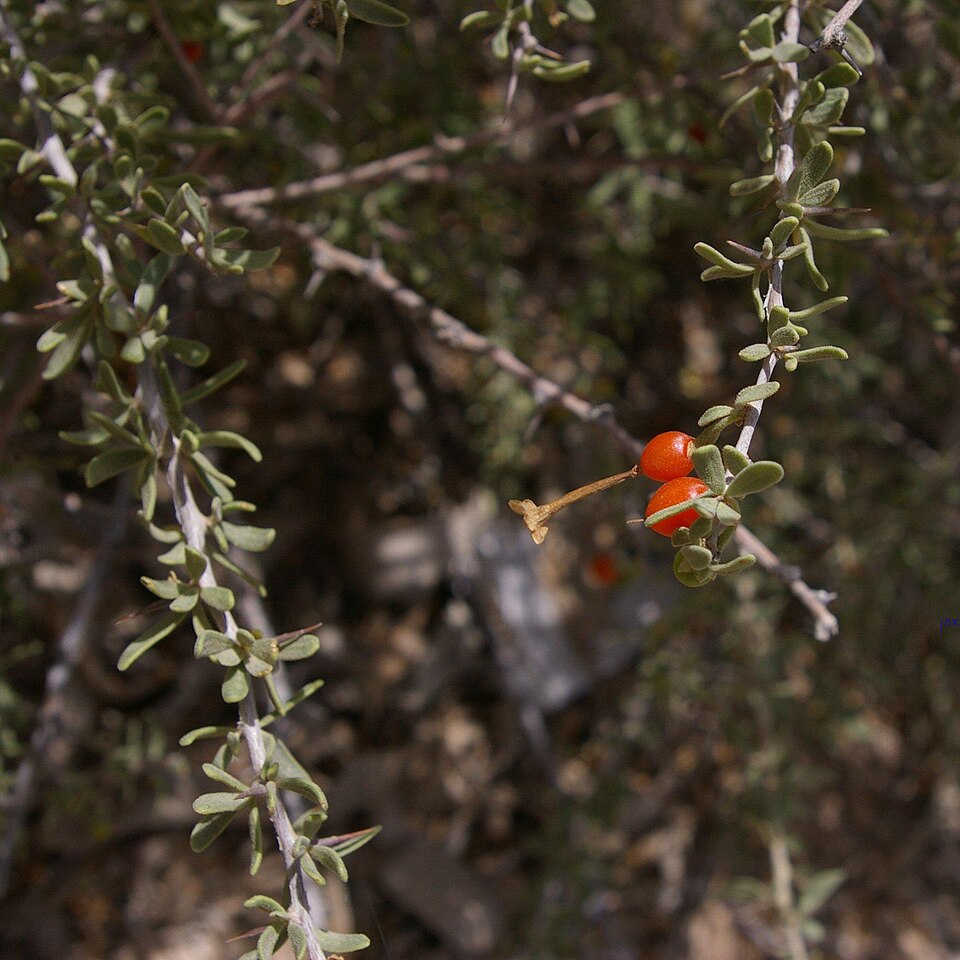

Lycium shawii, desert thorn or Arabian boxthorn is a species of thorny shrub adapted to desert environments, and can be found throughout the Arabian Peninsula, and some places in Africa. The thin leaved, rigid bush grows up to 3 metres (9.8 feet) high, with a lot of branches and alternating spines that vary in size, and grow along the branches and on their tips. The leaves narrow towards their base. It produces small whitish-pink or purple flowers from September until April, and red pea-sized seedy berries that are edible. Habitats include gravel plains and foothills up to 4,000 ft (1,200 m), as well as wadis. Plants often growing nearby include Acacia tortilis and Prosopis cineraria.
From Wikipedia, under CC BY-SA 4.0.
Is it poisonous?
We have no record of Arabian boxthorn being toxic, poisonous or venomous. That is not proof that it is safe. Never eat, touch or handle a wild plant, mushroom or animal on the strength of an identification; ask someone qualified.
Easily confused with
- Lycium bosciifolium
- Lycium schweinfurthii
- Lycium sokotranum
- Lycium europaeum
- Lycium horridum
- Lycium exsertum
Classification
- Kingdom
- Plantae
- Phylum
- Tracheophyta
- Class
- Magnoliopsida
- Order
- Solanales
- Family
- Solanaceae
- Genus
- Lycium
- Species
- Lycium shawii
Found one? Take a photo and B.inomen will suggest what it is, free.
Check your photo