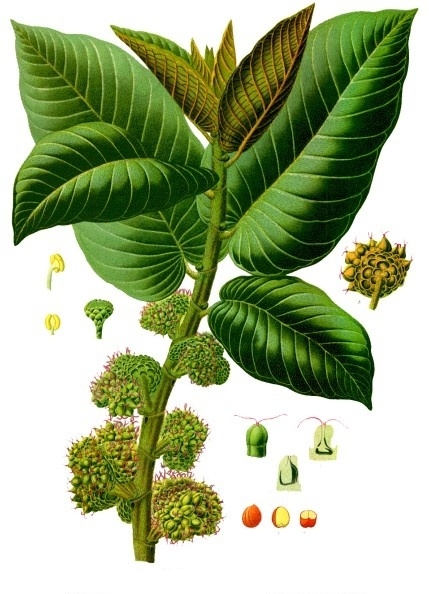

Castilla elastica, the Panama rubber tree, is a tree native to the tropical areas of Mexico, Central America, and northern South America. It was the principal source of latex among the Mesoamerican peoples in pre-Columbian times. The latex gathered from Castilla elastica was converted into usable rubber by mixing the latex with the juice of the morning glory species Ipomoea alba which, conveniently, is typically found in the wild as a vine climbing Castilla elastica. The rubber produced by this method found several uses, including most notably, the manufacture of balls for the Mesoamerican ballgame ōllamaliztli.
From Wikipedia, under CC BY-SA 4.0.
Is it poisonous?
We have no record of Panama rubber tree being toxic, poisonous or venomous. That is not proof that it is safe. Never eat, touch or handle a wild plant, mushroom or animal on the strength of an identification; ask someone qualified.
Easily confused with
- Virola surinamensis
- Milicia excelsa
- Casearia laetioides
- Antiaris toxicaria
- Artocarpus lacucha
- Ficus semicordata
Classification
- Kingdom
- Plantae
- Phylum
- Tracheophyta
- Class
- Magnoliopsida
- Order
- Rosales
- Family
- Moraceae
- Genus
- Castilla
- Species
- Castilla elastica
Found one? Take a photo and B.inomen will suggest what it is, free.
Check your photo