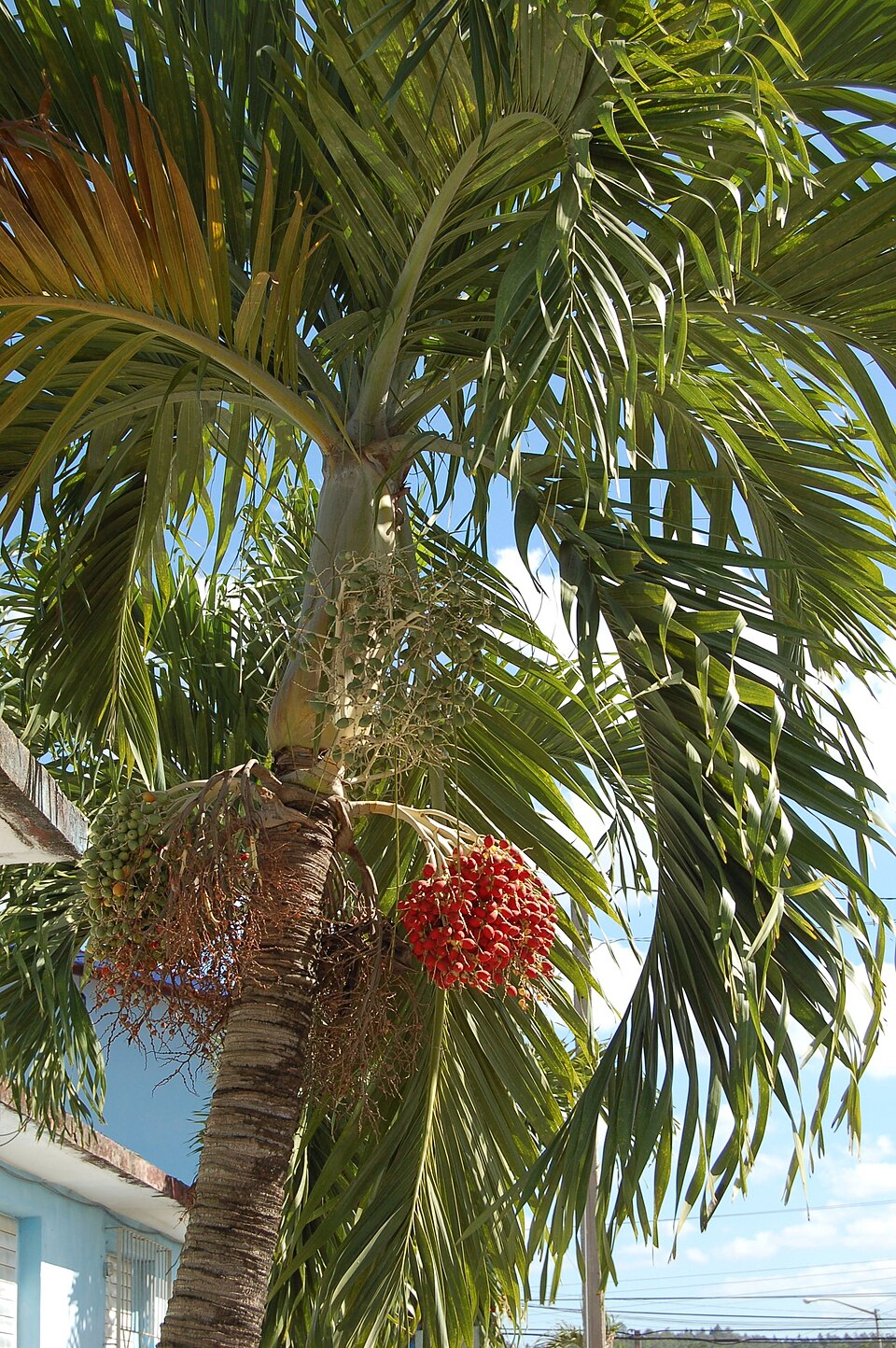

Adonidia merrillii, the Manila palm, is a palm tree species endemic to the Philippines (Palawan and Danjugan Island). This palm was cultivated for centuries in the Philippines before becoming a staple in the West. It is reportedly naturalized in the West Indies and Florida. It is commonly known as the "Christmas palm" because its fruits become bright scarlet and tend to be that color in winter. This palm is typically fairly small and slender, normally attaining 25 feet or 8 meters in height but has attained over 40 feet in some instances. Most plants maintain 5-7 fronds when young, gradually building up the crown as the palm ages, and sometimes reaches 10-12 fronds when mature.
From Wikipedia, under CC BY-SA 4.0.
Is it poisonous?
We have no record of Manila Palm being toxic, poisonous or venomous. That is not proof that it is safe. Never eat, touch or handle a wild plant, mushroom or animal on the strength of an identification; ask someone qualified.
Easily confused with
- Hyophorbe verschaffeltii
- Veitchia arecina
- Areca catechu — considered toxic
- Wodyetia bifurcata
- Hyophorbe lagenicaulis
Classification
- Kingdom
- Plantae
- Phylum
- Tracheophyta
- Class
- Liliopsida
- Order
- Arecales
- Family
- Arecaceae
- Genus
- Adonidia
- Species
- Adonidia merrillii
Found one? Take a photo and B.inomen will suggest what it is, free.
Check your photo