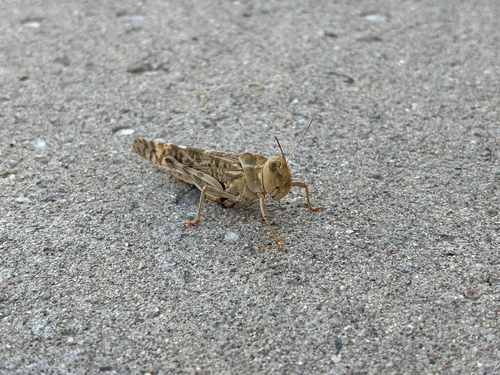
Dissosteira longipennis, the high plains locust, is a species of band-winged grasshopper in the family Acrididae. It is found in North America, specifically on the High Plains, consistently from eastern Wyoming and western Nebraska to eastern New Mexico and northwest Texas, and sometimes as far south as South Texas, north to Montana, and east to Iowa; it is now most common in Colorado and Kansas. During the 1930s, it formed enormous swarms and caused significant damage to crops in the western United States, but it is now very rare and has not swarmed since. However rare, the species is still extant, unlike the Rocky Mountain locust, the only other species of locust found in North America.
From Wikipedia, under CC BY-SA 4.0.
Is it venomous or poisonous?
We have no record of High Plains Locust being toxic, poisonous or venomous. That is not proof that it is safe. Never eat, touch or handle a wild plant, mushroom or animal on the strength of an identification; ask someone qualified.
Easily confused with
- Locustana pardalina
- Dissosteira spurcata
- Pardalophora saussurei
- Pardalophora haldemanii
- Metator pardalinus
Classification
- Kingdom
- Animalia
- Phylum
- Arthropoda
- Class
- Insecta
- Order
- Orthoptera
- Family
- Acrididae
- Genus
- Dissosteira
- Species
- Dissosteira longipennis
Found one? Take a photo and B.inomen will suggest what it is, free.
Check your photo