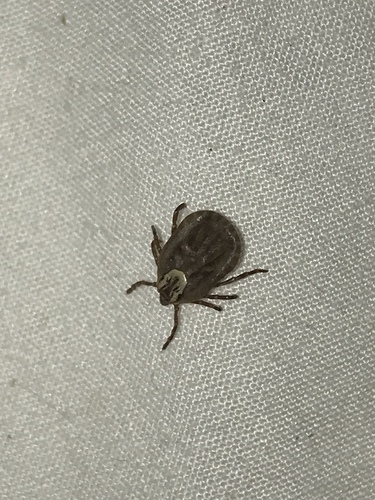
Dermacentor andersoni, commonly known as the Rocky Mountain wood tick, is a hard tick, or member of the Ixodidae family, with three life stages including larvae, nymph, and finally adult, or, more entomologically, imago. This tick is generally located in the northwest United States and southwest Canada along the Rocky Mountains. This tick is generally a vector for Colorado tick fever, but can also be a vector for Rocky Mountain spotted fever and tularemia. During the larval and nymphal stages, the tick does not feed on humans, but during the adult stage, it will.
From Wikipedia, under CC BY-SA 4.0.
Is it venomous or poisonous?
We have no record of Rocky Mountain Wood Tick being toxic, poisonous or venomous. That is not proof that it is safe. Never eat, touch or handle a wild plant, mushroom or animal on the strength of an identification; ask someone qualified.
Easily confused with
- Dermacentor similis
- Dermacentor variabilis
- Dermacentor reticulatus
- Dermacentor occidentalis
- Dermacentor marginatus
- Amblyomma maculatum
Classification
- Kingdom
- Animalia
- Phylum
- Arthropoda
- Class
- Arachnida
- Order
- Ixodida
- Family
- Ixodidae
- Genus
- Dermacentor
- Species
- Dermacentor andersoni
Found one? Take a photo and B.inomen will suggest what it is, free.
Check your photo