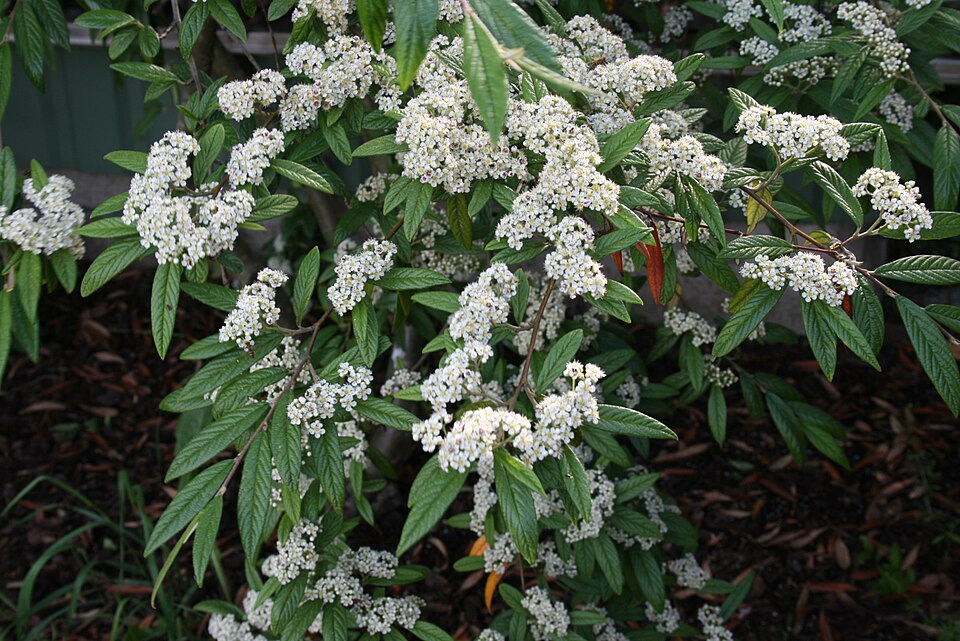

Cotoneaster salicifolius, the willow-leaved cotoneaster, is a drought-tolerant, evergreen to semi-evergreen, low-lying, small to medium-sized shrub with an arched branching habit. Specimens growing in the wild, however, are generally larger, averaging five meters in height. Although native to the mountains, mixed forests, and open places in western China, it is commonly cultivated in temperate climates worldwide. Cultivars have been bred in a variety of forms, as ornamental groundcovers or shrubs.
From Wikipedia, under CC BY-SA 4.0.
Is it poisonous?
We have no record of Willow-leaved Cotoneaster being toxic, poisonous or venomous. That is not proof that it is safe. Never eat, touch or handle a wild plant, mushroom or animal on the strength of an identification; ask someone qualified.
Easily confused with
Classification
- Kingdom
- Plantae
- Phylum
- Tracheophyta
- Class
- Magnoliopsida
- Order
- Rosales
- Family
- Rosaceae
- Genus
- Cotoneaster
- Species
- Cotoneaster salicifolius
Found one? Take a photo and B.inomen will suggest what it is, free.
Check your photo