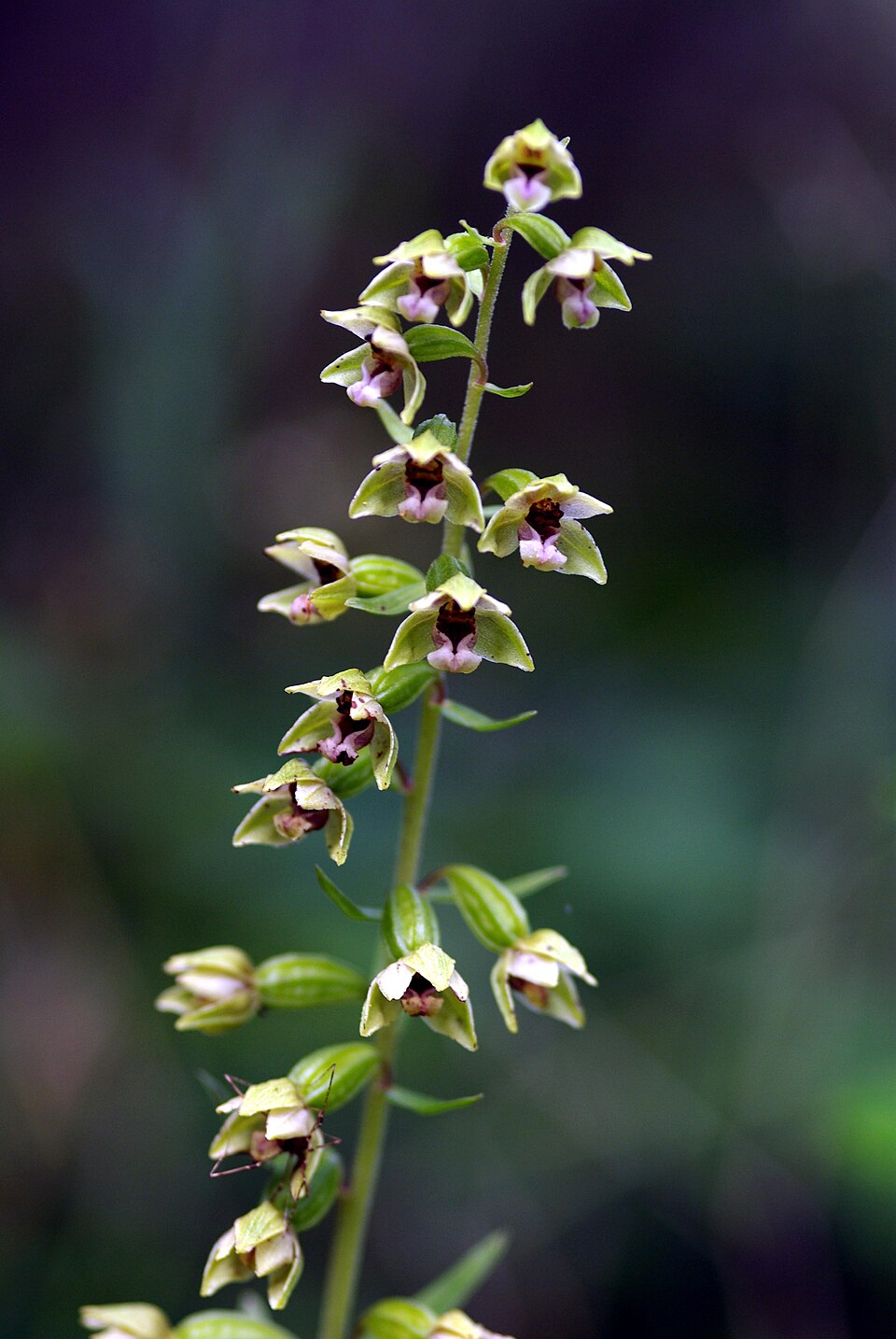

Epipactis dunensis, commonly known as dune helleborine, is a species of plant in the orchid family Orchidaceae and is endemic to Great Britain and Ireland. It typically grows to a height of 20–50 cm (7.9–19.7 in) and the upper half of the flowering stalk is hairy. The plant has a long, fleshy rootstock and three to ten yellowish green, oval to lance-shaped leaves arranged in opposite rows along the flowering stem with up to 35 flowers. The three sepals are greenish, the two petals paler, the lower part of the labellum (the hypochile) is boat-shaped and dark, chocolate brown with a transparent, whitish rim and the epichile is heart-shaped with a pointed tip.
From Wikipedia, under CC BY-SA 4.0.
Is it poisonous?
We have no record of Dune Helleborine being toxic, poisonous or venomous. That is not proof that it is safe. Never eat, touch or handle a wild plant, mushroom or animal on the strength of an identification; ask someone qualified.
Easily confused with
- Epipactis bugacensis
- Epipactis phyllanthes
- Epipactis muelleri
- Epipactis albensis
- Epipactis leptochila
- Epipactis papillosa
Classification
- Kingdom
- Plantae
- Phylum
- Tracheophyta
- Class
- Liliopsida
- Order
- Asparagales
- Family
- Orchidaceae
- Genus
- Epipactis
- Species
- Epipactis dunensis
Found one? Take a photo and B.inomen will suggest what it is, free.
Check your photo