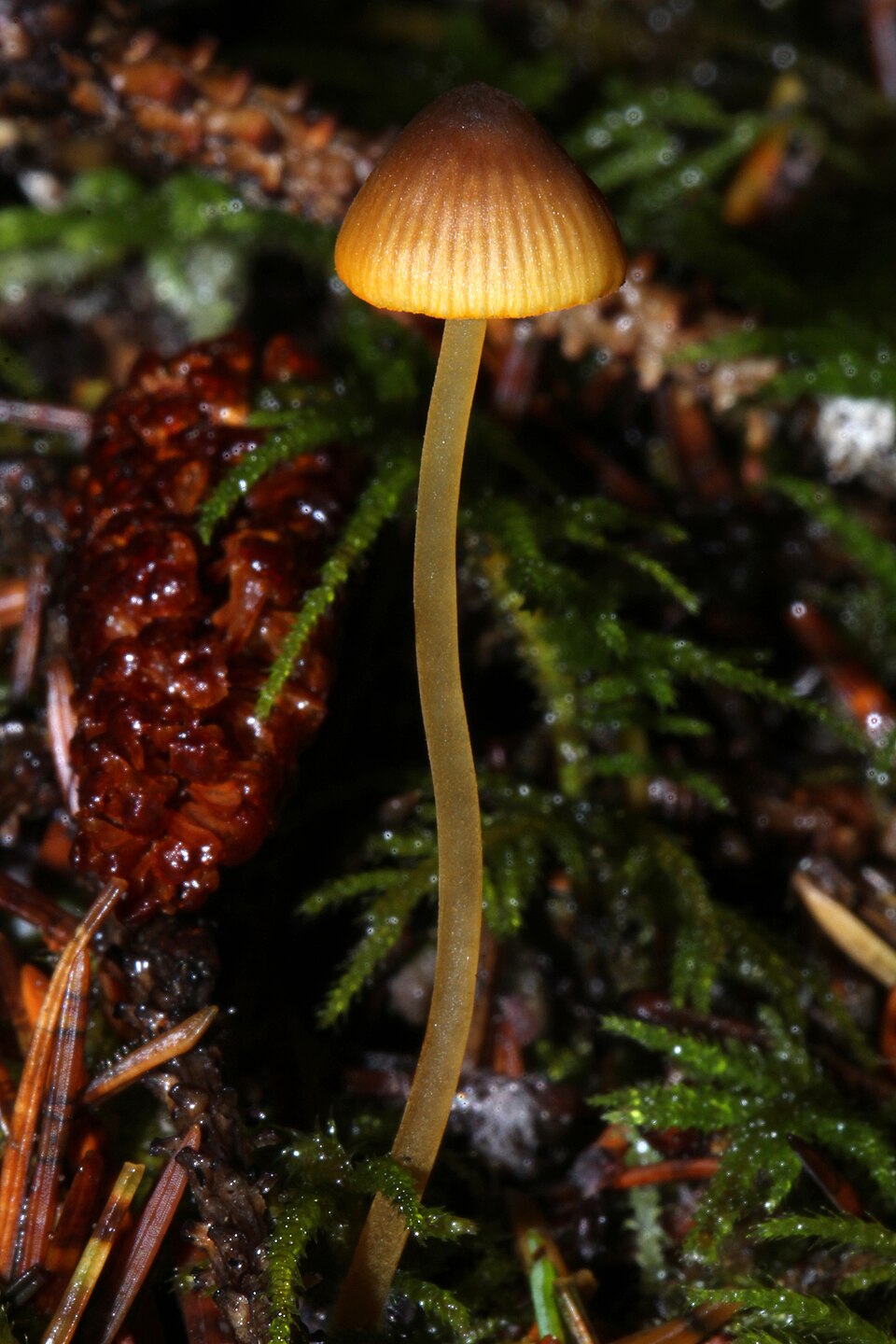

Mycena aurantiomarginata, commonly known as the golden-edge bonnet, is a species of agaric fungus in the family Mycenaceae. First formally described in 1803, it was given its current name in 1872. Widely distributed, it is common in Europe and North America, and has also been collected in North Africa, Central America, and Japan. The fungus is saprobic, and produces fruit bodies (mushrooms) that grow on the floor of coniferous forests. The mushrooms have a bell-shaped to conical cap up to 2 cm (3⁄4 in) in diameter, set atop a slender stipe up to 6 cm (2+3⁄8 in) long with yellow to orange hairs at the base. The fungus is named after its characteristic bright orange gill edges.
From Wikipedia, under CC BY-SA 4.0.
Is it poisonous?
We have no record of Goldenedge bonnet being toxic, poisonous or venomous. That is not proof that it is safe. Never eat, touch or handle a wild plant, mushroom or animal on the strength of an identification; ask someone qualified.
Easily confused with
- Mycena citrinomarginata
- Galerina vittiformis — considered toxic
- Galerina atkinsoniana — considered toxic
Classification
- Kingdom
- Fungi
- Phylum
- Basidiomycota
- Class
- Agaricomycetes
- Order
- Agaricales
- Family
- Mycenaceae
- Genus
- Mycena
- Species
- Mycena aurantiomarginata
Found one? Take a photo and B.inomen will suggest what it is, free.
Check your photo