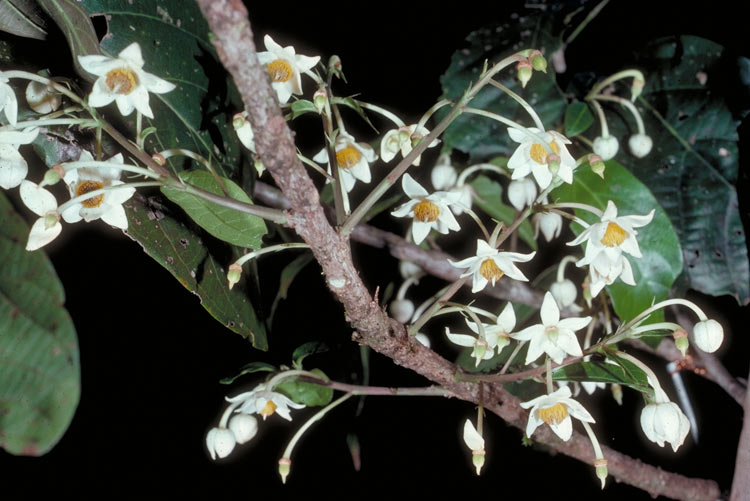

Sloanea langii, commonly known as the white carabeen, is a species of plant in the family Elaeocarpaceae found only in the state of Queensland, Australia. It is a large tree up to 35 m (115 ft) tall with large buttress roots. The leaves are generally about 6–14 cm (2.4–5.5 in) long and 3–6 cm (1.2–2.4 in) wide, and held on a petiole up to 4 cm (1.6 in) long. Flowers have four white sepals and four white petals, about 50–90 stamens, and an ovary that is about 3 mm (0.12 in) long. The dehiscent fruit have 3 or 4 valves with generally one seed per valve. They are bronze/yellow and densely covered in bristles.
From Wikipedia, under CC BY-SA 4.0.
Is it poisonous?
We have no record of White Carabeen being toxic, poisonous or venomous. That is not proof that it is safe. Never eat, touch or handle a wild plant, mushroom or animal on the strength of an identification; ask someone qualified.
Easily confused with
- Sloanea berteroana
- Sloanea dasycarpa
- Rockinghamia angustifolia
- Ficus copiosa
- Hieronyma alchorneoides
- Sloanea grandiflora
Classification
- Kingdom
- Plantae
- Phylum
- Tracheophyta
- Class
- Magnoliopsida
- Order
- Oxalidales
- Family
- Elaeocarpaceae
- Genus
- Sloanea
- Species
- Sloanea langii
Found one? Take a photo and B.inomen will suggest what it is, free.
Check your photo