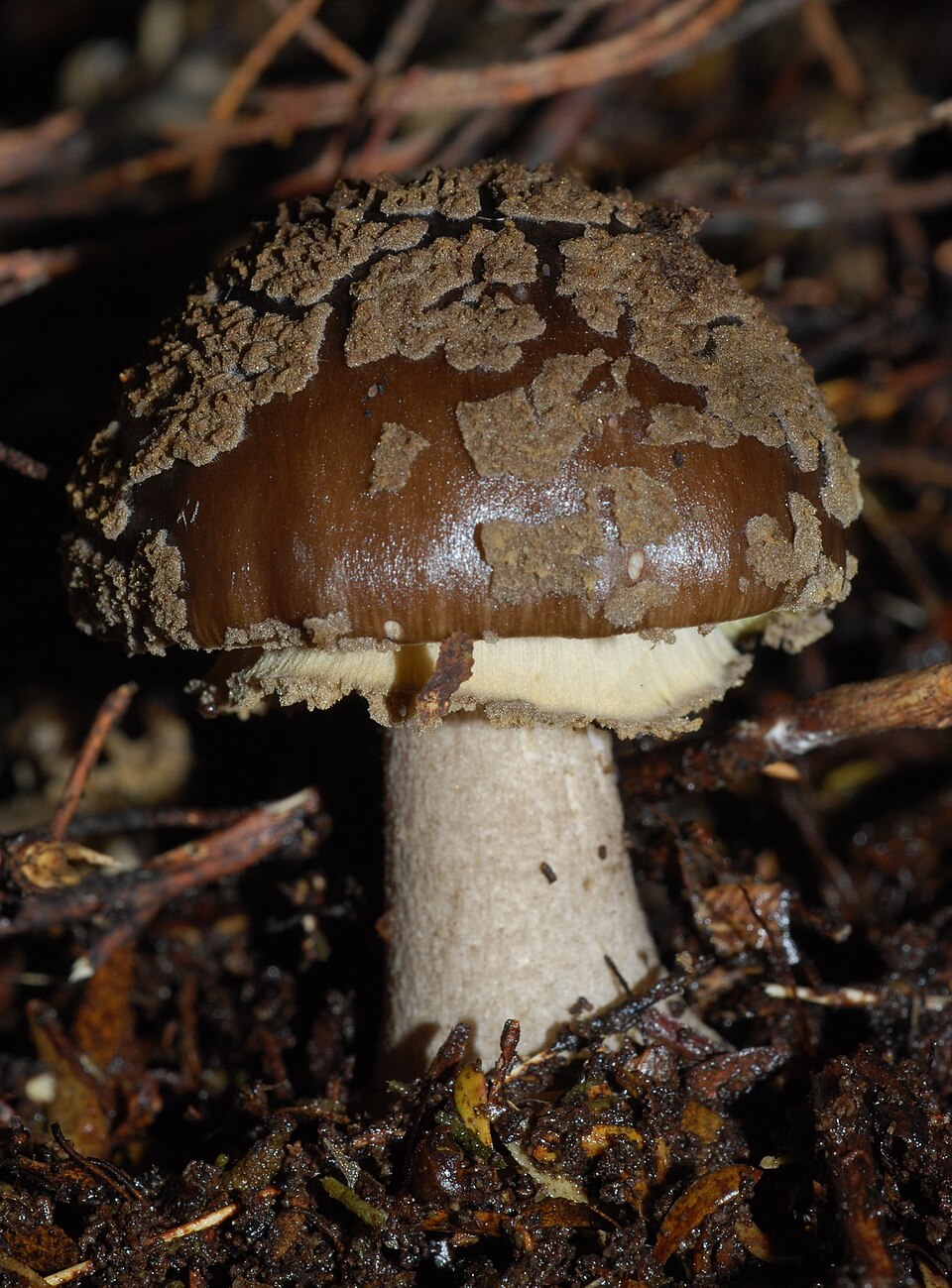

Amanita nothofagi is a species of fungus in the family Amanitaceae. Endemic to New Zealand, the species was first described by mycologist Greta Stevenson in 1962. The fruit bodies have dark brown caps that are up to 13 cm (5.1 in) in diameter and covered with patches of soft greyish-brown scales or warts. The gills underneath the cap are crowded together, free from attachment to the stem, and white, becoming tinged with yellow in age. The stem of the mushroom is 4–14 cm (1.6–5.5 in) long by 0.5–2.5 cm (0.2–1.0 in) thick, and has a ring. The spore print is white, and individual spores are spherical to ellipsoid, measuring 7.5–9 by 7.5–9 micrometres.
From Wikipedia, under CC BY-SA 4.0.
Is it poisonous?
Considered toxic. Public sources list it as such; we have not verified this individually. The note covers its whole genus. Genus holds the deadliest mushrooms; several species are edible but none should be eaten without expert identification Never eat, touch or handle a wild plant, mushroom or animal on the strength of an identification; ask someone qualified.
Easily confused with
- Amanita australis — considered toxic
- Russula griseoviridis
- Amanita merxmuelleri — considered toxic
- Amanita luteolovelata — considered toxic
Classification
- Kingdom
- Fungi
- Phylum
- Basidiomycota
- Class
- Agaricomycetes
- Order
- Agaricales
- Family
- Amanitaceae
- Genus
- Amanita
- Species
- Amanita nothofagi
Found one? Take a photo and B.inomen will suggest what it is, free.
Check your photo