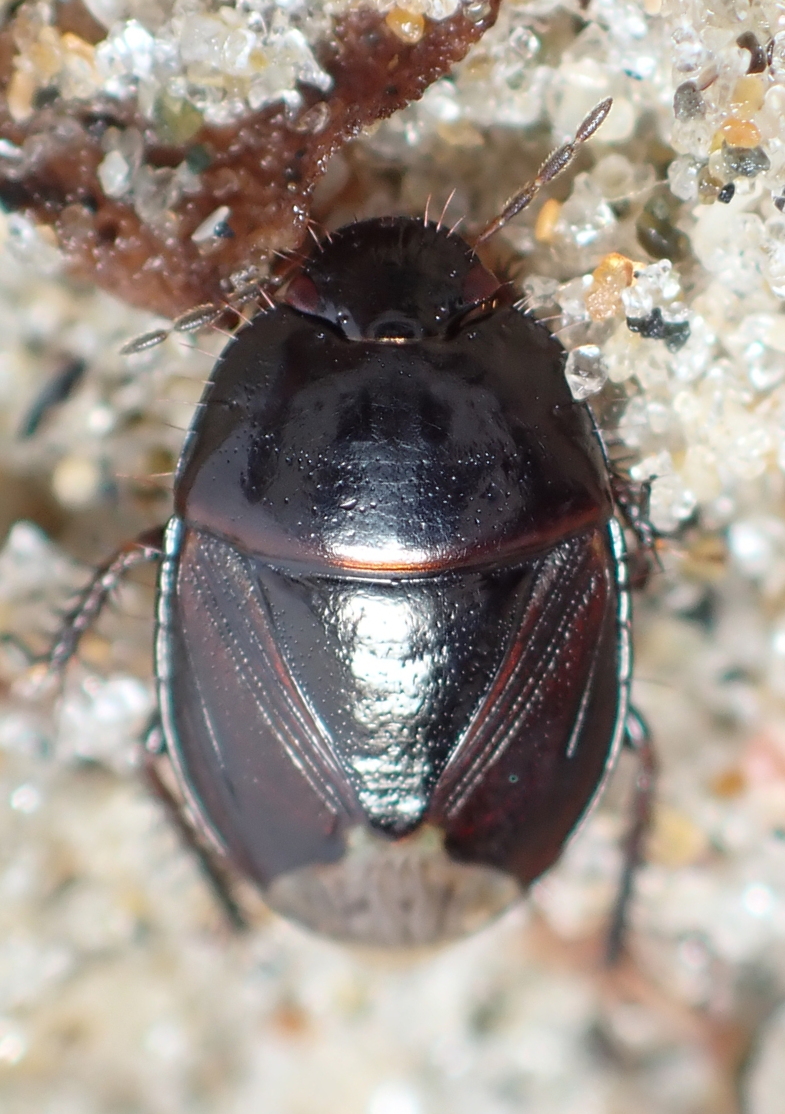

Macroscytus australis is a species of burrowing bug native to Australia, Indonesia, New Caledonia and New Zealand. They were first formally described in 1842 by Wilhelm Ferdinand Erichson. Typically, they occur in open sandy areas with varying amounts of vegetation such as the seashore, but can also be found at high altitudes and in floodplains. They are often found hiding under rocks and other debris such as rotting wood. Adults can be found throughout most of the year, except for June and July. Eggs are laid from November to February, with juveniles taking 44–52 days to reach maturity. They are known to feed on grass seeds, including those of Poa annua.
From Wikipedia, under CC BY-SA 4.0.
Is it venomous or poisonous?
We have no record of Macroscytus australis being toxic, poisonous or venomous. That is not proof that it is safe. Never eat, touch or handle a wild plant, mushroom or animal on the strength of an identification; ask someone qualified.
Easily confused with
- Macroscytus brunneus
- Pangaeus bilineatus
- Microporus nigrita
- Geotomus elongatus
- Sehirus luctuosus
- Adrisa magna
Classification
- Kingdom
- Animalia
- Phylum
- Arthropoda
- Class
- Insecta
- Order
- Hemiptera
- Family
- Cydnidae
- Genus
- Macroscytus
- Species
- Macroscytus australis
Found one? Take a photo and B.inomen will suggest what it is, free.
Check your photo