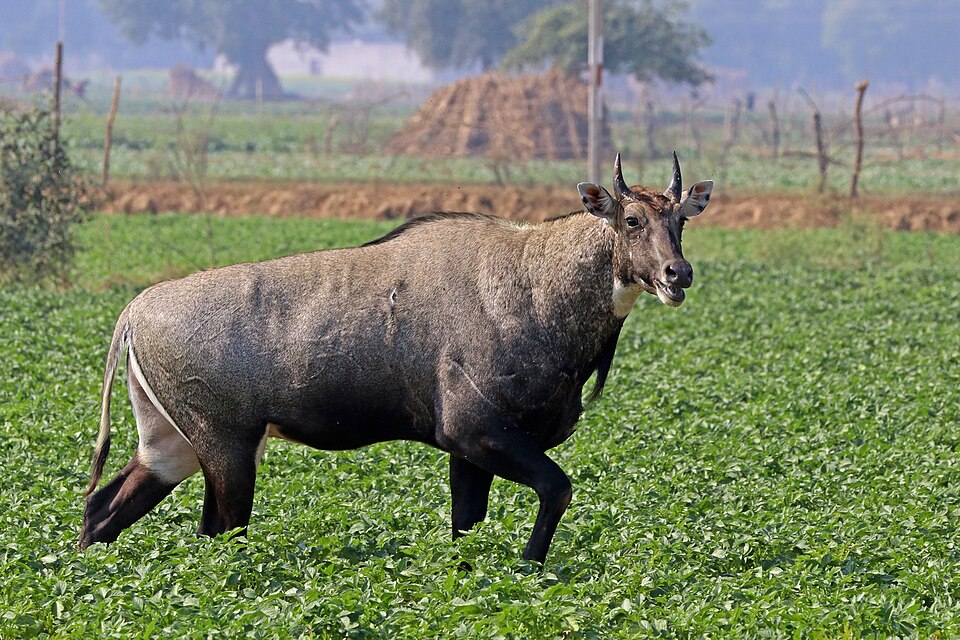

The nilgai (Boselaphus tragocamelus) (, literally meaning "blue cow") is the largest antelope in Asia. It is ubiquitous across the northern Indian subcontinent. It is the sole living member of the genus Boselaphus, which was first scientifically described by Peter Simon Pallas in 1766. It is a sturdy, thin-legged antelope with a sloping back, a deep neck with a white patch on the throat, a short crest of hair along the neck terminating in a tuft, and white facial spots. A column of pendant, coarse hair hangs from the dewlap ridge below the white patch. It stands 100–150 cm (39–59 in) at the shoulder; males weigh 109–288 kg (240–635 lb), and the lighter females 100–213 kg (220–470 lb).
From Wikipedia, under CC BY-SA 4.0.
Is it venomous or poisonous?
We have no record of Nilgai being toxic, poisonous or venomous. That is not proof that it is safe. Never eat, touch or handle a wild plant, mushroom or animal on the strength of an identification; ask someone qualified.
Easily confused with
Classification
- Kingdom
- Animalia
- Phylum
- Chordata
- Class
- Mammalia
- Order
- Artiodactyla
- Family
- Bovidae
- Genus
- Boselaphus
- Species
- Boselaphus tragocamelus
Found one? Take a photo and B.inomen will suggest what it is, free.
Check your photo