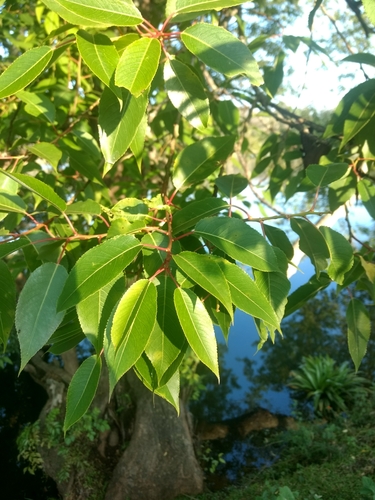
Salix tetrasperma, commonly called Indian willow, is a medium-sized tree of wet and swampy places, shedding its leaves at the end of monsoon season. It flowers after leafing. The bark is rough, with deep, vertical fissures and the young shoots leaves are silky. The leaves are lance-like, or ovate-lancelike, 8–15 cm long, with minutely and regularly toothed margins. The male sweet scented catkins are 5–10 cm long, and are borne on leafy branchlets. The female catkins are 8–12 cm long. The capsules are long, stipulate, in groups of 3 to 4.
From Wikipedia, under CC BY-SA 4.0.
Is it poisonous?
We have no record of Indian Willow being toxic, poisonous or venomous. That is not proof that it is safe. Never eat, touch or handle a wild plant, mushroom or animal on the strength of an identification; ask someone qualified.
Easily confused with
Classification
- Kingdom
- Plantae
- Phylum
- Tracheophyta
- Class
- Magnoliopsida
- Order
- Malpighiales
- Family
- Salicaceae
- Genus
- Salix
- Species
- Salix tetrasperma
Found one? Take a photo and B.inomen will suggest what it is, free.
Check your photo