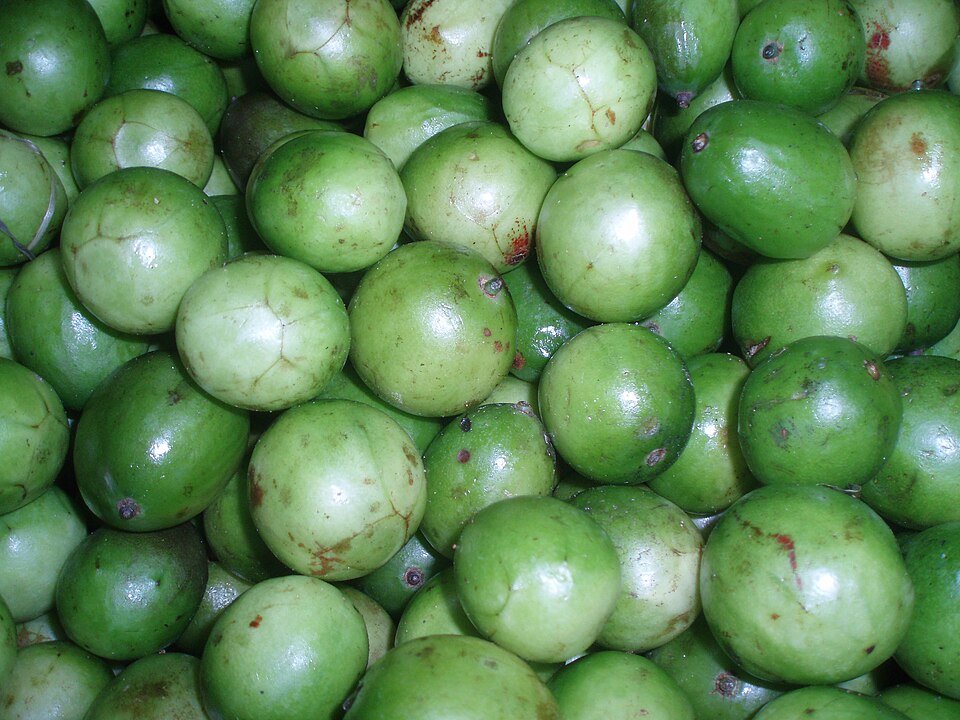

Spondias tuberosa, commonly known as imbu, Portuguese pronunciation: [ũˈbu], [ĩˈbu] Brazil plum, or umbu, is a plant native to northeast Brazil, where it grows in the Caatinga, the chaparral scrub that grows wild across dry lands. The round fruit is light yellow to red, around 2–4 cm in size, and has a leathery shell. The flesh is soft and juicy, with a sweet taste and distinct aroma. The fruit comes from a small tree, seldom higher than 6 m, with an expansive crown that can reach 10 m in diameter. The fruit of the imbu are round and can be of varying size: they can be as small as cherries or as large as lemons.
From Wikipedia, under CC BY-SA 4.0.
Is it poisonous?
We have no record of Brazil plum being toxic, poisonous or venomous. That is not proof that it is safe. Never eat, touch or handle a wild plant, mushroom or animal on the strength of an identification; ask someone qualified.
Easily confused with
- Commiphora leptophloeos
- Sclerocarya birrea
- Aspidosperma pyrifolium
- Lannea schweinfurthii
- Phyllanthus chacoensis
Classification
- Kingdom
- Plantae
- Phylum
- Tracheophyta
- Class
- Magnoliopsida
- Order
- Sapindales
- Family
- Anacardiaceae
- Genus
- Spondias
- Species
- Spondias tuberosa
Found one? Take a photo and B.inomen will suggest what it is, free.
Check your photo