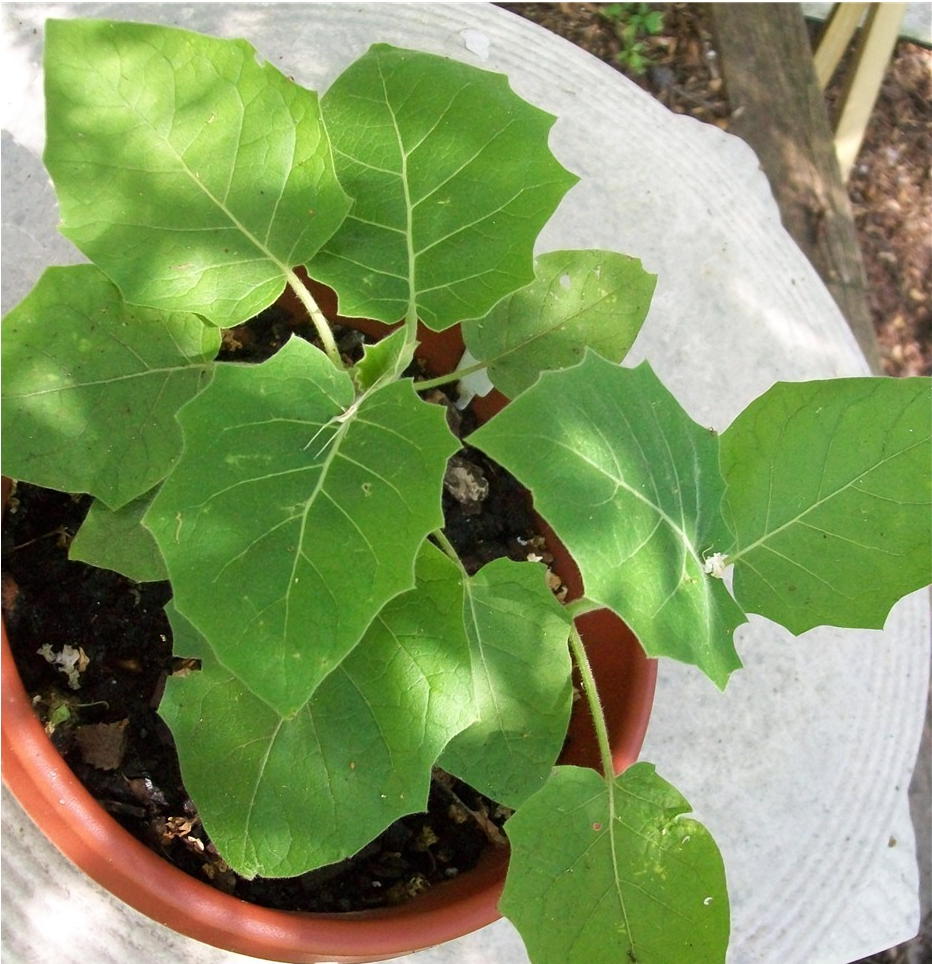

Solanum sessiliflorum, the cocona, is a tropical shrub of the family Solanaceae. The cocona plant has sturdy branches and huge, serrate and hairy leaves. Cocona closely resembles a number of close relatives, including naranjilla (S. quitoense) and pseudolulo (S. pseudolulo.) It can be distinguished from those plants by its lack of spines. It will hybridize with those and other close relatives. Cocona also lacks the characteristic purple coloring usually seen in the naranjilla. Its flowers resemble large potato flowers, with light green petals. Cocona is harvested in parts of South America around the Amazon rainforest such as Purús Province in eastern Peru.
From Wikipedia, under CC BY-SA 4.0.
Is it poisonous?
We have no record of Cocona being toxic, poisonous or venomous. That is not proof that it is safe. Never eat, touch or handle a wild plant, mushroom or animal on the strength of an identification; ask someone qualified.
Easily confused with
- Solanum lasiocarpum
- Solanum quitoense
- Solanum candidum
- Solanum robustum
- Solanum hirtum
- Solanum vestissimum
Classification
- Kingdom
- Plantae
- Phylum
- Tracheophyta
- Class
- Magnoliopsida
- Order
- Solanales
- Family
- Solanaceae
- Genus
- Solanum
- Species
- Solanum sessiliflorum
Found one? Take a photo and B.inomen will suggest what it is, free.
Check your photo