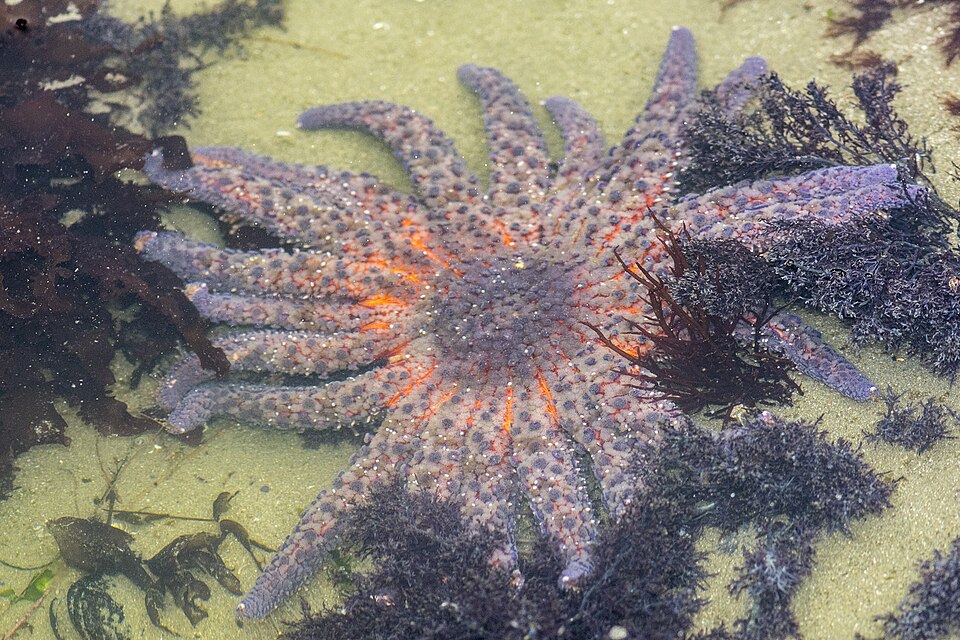

Pycnopodia helianthoides, commonly known as the sunflower sea star, is a large sea star found in the northeastern Pacific Ocean. The only species of its genus, it is among the largest sea stars in the world, with a maximum arm span of 1 m (3.3 ft). Adult sunflower sea stars usually have 16 to 24 limbs. They vary in color. Sunflower sea stars are predatory and carnivorous, feeding mostly on sea urchins, clams, sea snails, and other small invertebrates. Although the species was widely distributed throughout the northeast Pacific, its population rapidly declined from 2013. The sunflower sea star is classified as Critically Endangered on the IUCN Red List.
From Wikipedia, under CC BY-SA 4.0.
Is it venomous or poisonous?
We have no record of Sunflower Sea Star being toxic, poisonous or venomous. That is not proof that it is safe. Never eat, touch or handle a wild plant, mushroom or animal on the strength of an identification; ask someone qualified.
Easily confused with
Classification
- Kingdom
- Animalia
- Phylum
- Echinodermata
- Class
- Asteroidea
- Order
- Forcipulatida
- Family
- Asteriidae
- Genus
- Pycnopodia
- Species
- Pycnopodia helianthoides
Found one? Take a photo and B.inomen will suggest what it is, free.
Check your photo