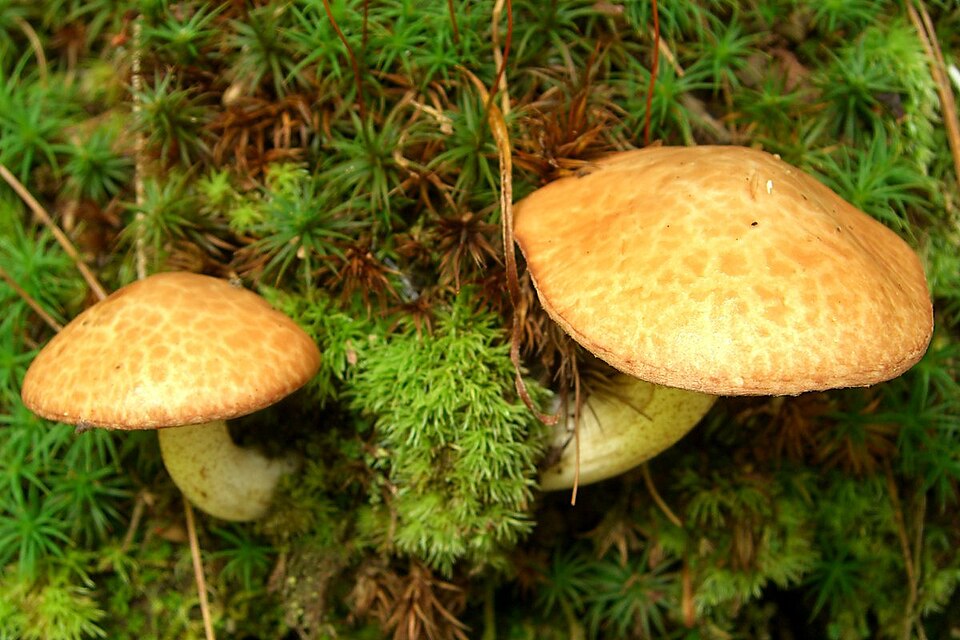

Suillus subaureus is a rare species of bolete fungus in the family Suillaceae. It is found in North America, where it associates with deciduous trees. Originally described in 1887 by Charles Horton Peck, it was transferred to genus Suillus by Wally Snell in 1944. Fruitbodies are pale yellow—reflecting its specific epithet subaureus, which means "somewhat golden yellow". The spore print is olive brown. Spores are smooth and inamyloid, and measure 7–10 by 2.7–3.5 μm. It has also been recorded in Taiwan.
From Wikipedia, under CC BY-SA 4.0.
Is it poisonous?
We have no record of Suillus subaureus being toxic, poisonous or venomous. That is not proof that it is safe. Never eat, touch or handle a wild plant, mushroom or animal on the strength of an identification; ask someone qualified.
Easily confused with
- Suillus americanus
- Suillus punctipes
- Suillus sibiricus
- Suillus hirtellus
- Suillus tomentosus
- Suillus decipiens
Classification
- Kingdom
- Fungi
- Phylum
- Basidiomycota
- Class
- Agaricomycetes
- Order
- Boletales
- Family
- Suillaceae
- Genus
- Suillus
- Species
- Suillus subaureus
Found one? Take a photo and B.inomen will suggest what it is, free.
Check your photo