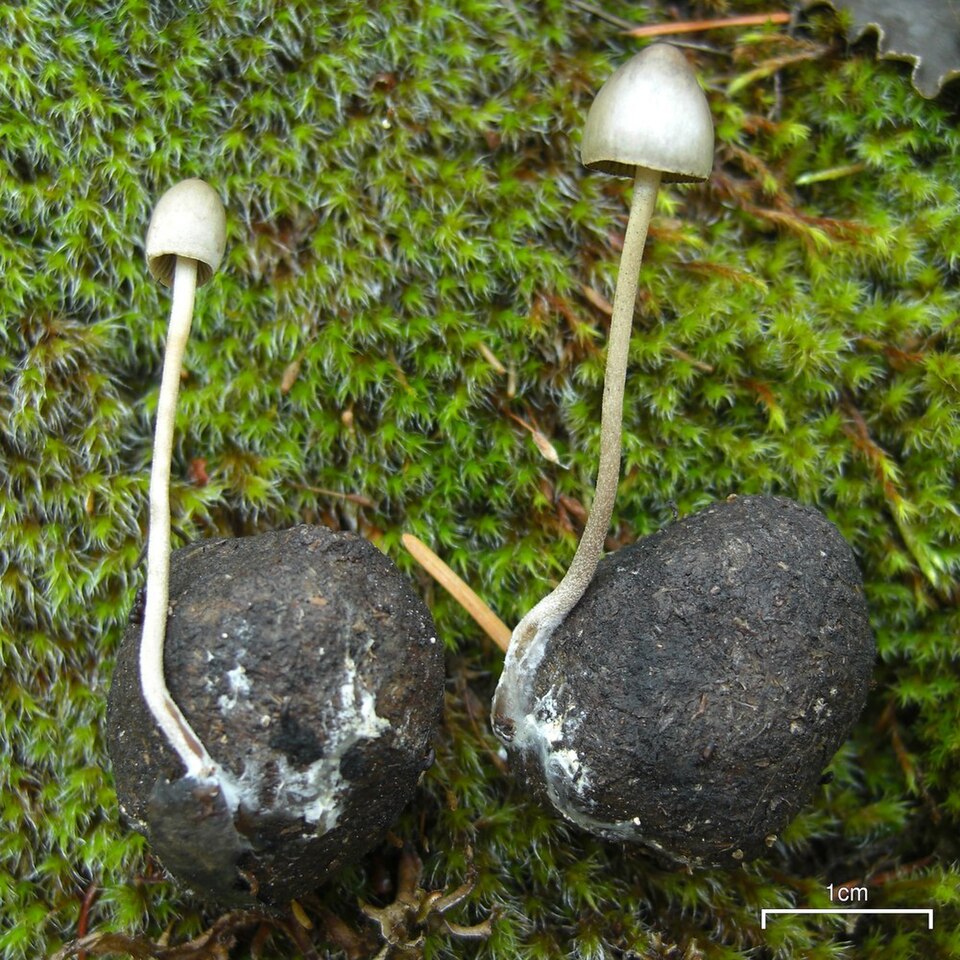

Panaeolus alcis is a species of agaric fungus in the family Bolbitiaceae. Found in Europe and Canada, it was described as new to science in 1984 by Austrian mycologist Meinhard Michael Moser. The type collection, made in Sweden, was found growing on moose dung. The fungus produces small, brown fruit bodies with bell-shaped to conical caps measuring 0.4–1 cm (0.2–0.4 in) in diameter and 0.3–0.9 cm (0.12–0.35 in) high. Gills are dark gray initially, then develop a black mottling when the spores mature. The gray to brownish stipe is 2–9 cm (0.8–3.5 in) long by 0.5–1.5 mm thick, and pruinose (covered with white powdery granules). Spores are smooth, dark brown, and have a pore.
From Wikipedia, under CC BY-SA 4.0.
Is it poisonous?
We have no record of Panaeolus alcis being toxic, poisonous or venomous. That is not proof that it is safe. Never eat, touch or handle a wild plant, mushroom or animal on the strength of an identification; ask someone qualified.
Easily confused with
Classification
- Kingdom
- Fungi
- Phylum
- Basidiomycota
- Class
- Agaricomycetes
- Order
- Agaricales
- Family
- Galeropsidaceae
- Genus
- Panaeolus
- Species
- Panaeolus alcis
Found one? Take a photo and B.inomen will suggest what it is, free.
Check your photo