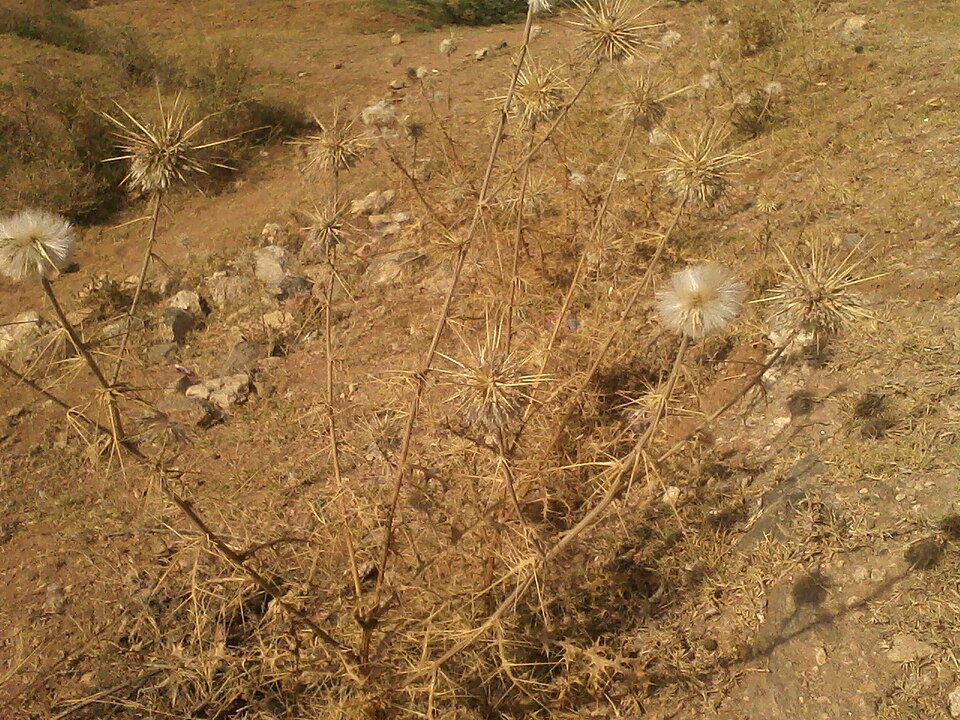

Echinops echinatus, the Indian globe thistle, commonly known as Usnakantaka, is a species of globe thistle, found in India, Pakistan, and Sri Lanka. Indian globe thistle is an erect branched herb about 100 cm high. It has short, stout stems, branching from the base, covered with white cottony hair. Alternately arranged oblong, deeply pinnatifid leaves are 7–12 cm long. Flower heads occur in solitary white spherical balls, 3–5 cm across. Petals of the tiny white disc florets are 5 mm long. Flowers are surrounded by straight, strong, white bristles. Often misidentified with Silybum marianum (L.) Gaertner, it is colloquially known as Camel's thistle.
From Wikipedia, under CC BY-SA 4.0.
Is it poisonous?
We have no record of Indian Globe Thistle being toxic, poisonous or venomous. That is not proof that it is safe. Never eat, touch or handle a wild plant, mushroom or animal on the strength of an identification; ask someone qualified.
Easily confused with
Classification
- Kingdom
- Plantae
- Phylum
- Tracheophyta
- Class
- Magnoliopsida
- Order
- Asterales
- Family
- Asteraceae
- Genus
- Echinops
- Species
- Echinops echinatus
Found one? Take a photo and B.inomen will suggest what it is, free.
Check your photo