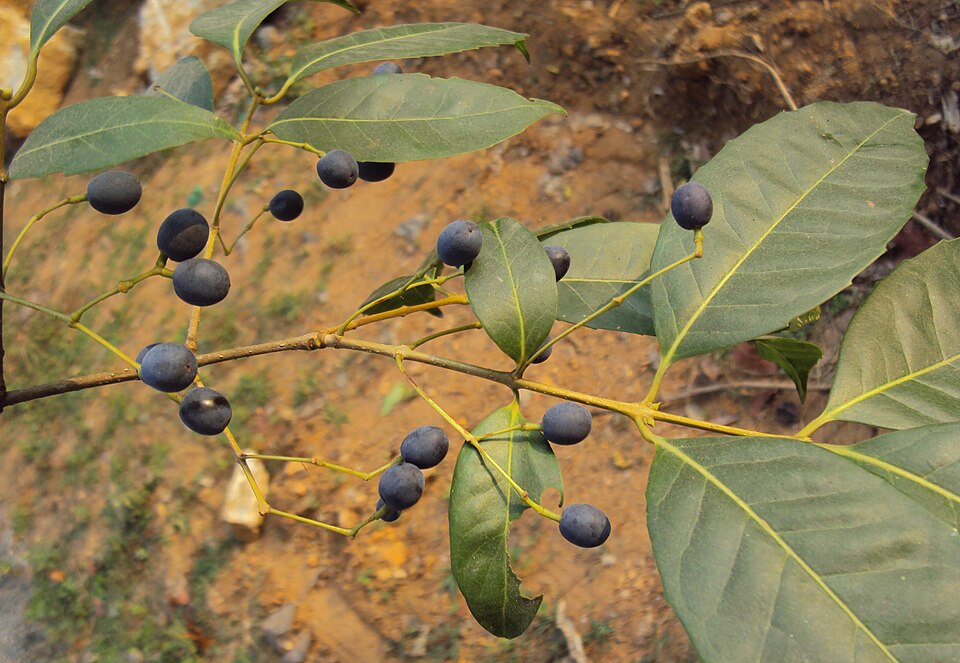

Tetrapilus dioicus, commonly known as rose sandalwood, is a tree species native to the Indian subcontinent, including Bangladesh, India, Nepal, and Myanmar. It grows up to 15 m tall, with smooth grey bark and oblong-elliptic, leathery leaves that are 7–12 cm long, either entire or with distant serrations. The species bears small greenish-white to pinkish-tinged flowers arranged in opposite panicles, usually blooming between December and March. Its fleshy, purplish circular fruits contribute to its presence in wet tropical regions, notably in places like Khandala and Mahabaleshwar in Maharashtra.
From Wikipedia, under CC BY-SA 4.0.
Is it poisonous?
We have no record of Olea dioica being toxic, poisonous or venomous. That is not proof that it is safe. Never eat, touch or handle a wild plant, mushroom or animal on the strength of an identification; ask someone qualified.
Easily confused with
Classification
- Kingdom
- Plantae
- Phylum
- Tracheophyta
- Class
- Magnoliopsida
- Order
- Lamiales
- Family
- Oleaceae
- Genus
- Olea
- Species
- Olea dioica
Found one? Take a photo and B.inomen will suggest what it is, free.
Check your photo