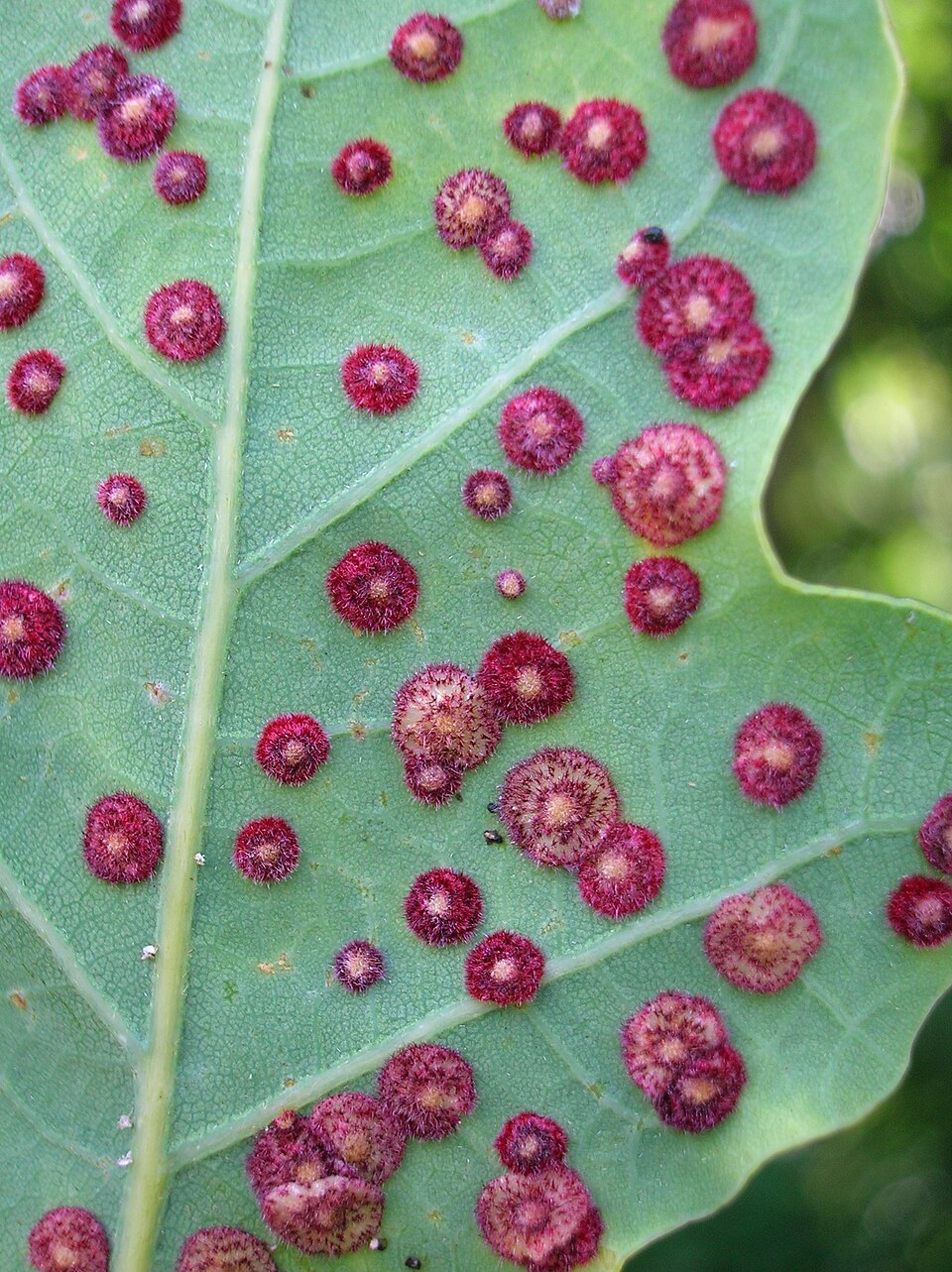

The common spangle gall on the underside of leaves and the currant gall on the male catkins or occasionally the leaves, develop as chemically induced distortions on pedunculate oak (Quercus robur), or sessile oak (Quercus petraea) trees, caused by the cynipid wasp Neuroterus quercusbaccarum which has both agamic and bisexual generations.
From Wikipedia, under CC BY-SA 4.0.
Is it venomous or poisonous?
We have no record of Common Spangle Gall Wasp being toxic, poisonous or venomous. That is not proof that it is safe. Never eat, touch or handle a wild plant, mushroom or animal on the strength of an identification; ask someone qualified.
Easily confused with
Classification
- Kingdom
- Animalia
- Phylum
- Arthropoda
- Class
- Insecta
- Order
- Hymenoptera
- Family
- Cynipidae
- Genus
- Neuroterus
- Species
- Neuroterus quercusbaccarum
Found one? Take a photo and B.inomen will suggest what it is, free.
Check your photo