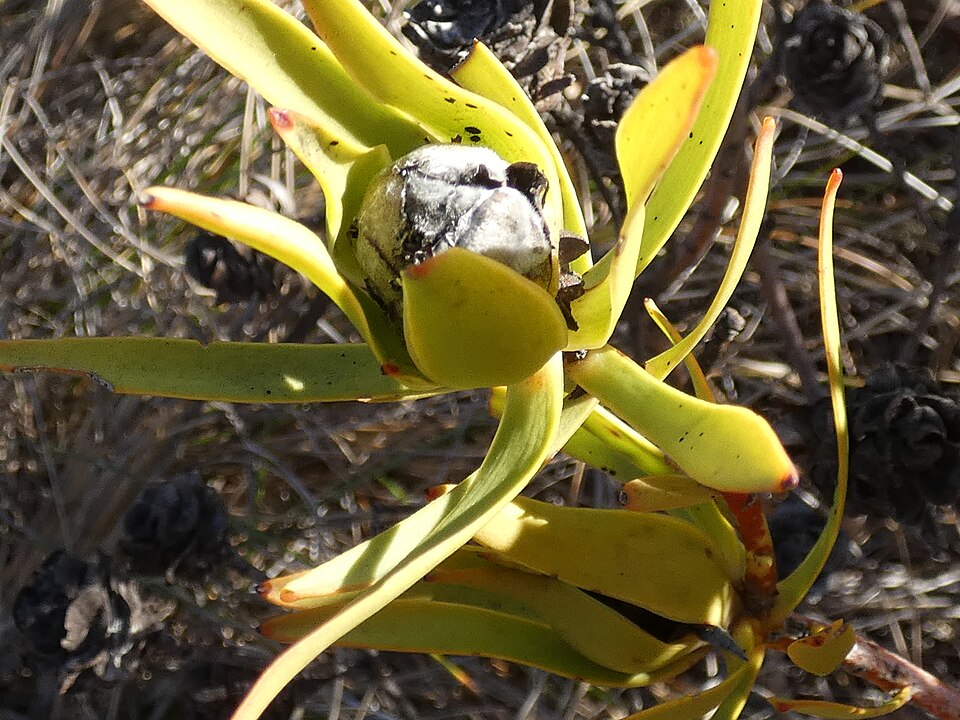

Leucadendron salignum, also known as the common sunshine conebush, is an evergreen, dioecious shrub in the family Proteaceae. It produces several stems from the ground of up to 2 metres (6 ft 7 in) high. It survives the wildfires that occur every one or two decades in the fynbos, where it occurs, by regrowing from an underground rootstock. Pollinated by beetles, it flowers from April to November. The winged seeds remain in the woody cones until they are released after a fire, and are distributed by the wind. It is possibly the most common Proteaceae species in South Africa, and can be found in the Northern Cape, Western Cape and Eastern Cape provinces.
From Wikipedia, under CC BY-SA 4.0.
Is it poisonous?
We have no record of Common Sunshine Conebush being toxic, poisonous or venomous. That is not proof that it is safe. Never eat, touch or handle a wild plant, mushroom or animal on the strength of an identification; ask someone qualified.
Easily confused with
- Leucadendron xanthoconus
- Leucadendron lanigerum
- Leucadendron foedum
- Leucadendron eucalyptifolium
- Leucadendron spissifolium
Classification
- Kingdom
- Plantae
- Phylum
- Tracheophyta
- Class
- Magnoliopsida
- Order
- Proteales
- Family
- Proteaceae
- Genus
- Leucadendron
- Species
- Leucadendron salignum
Found one? Take a photo and B.inomen will suggest what it is, free.
Check your photo