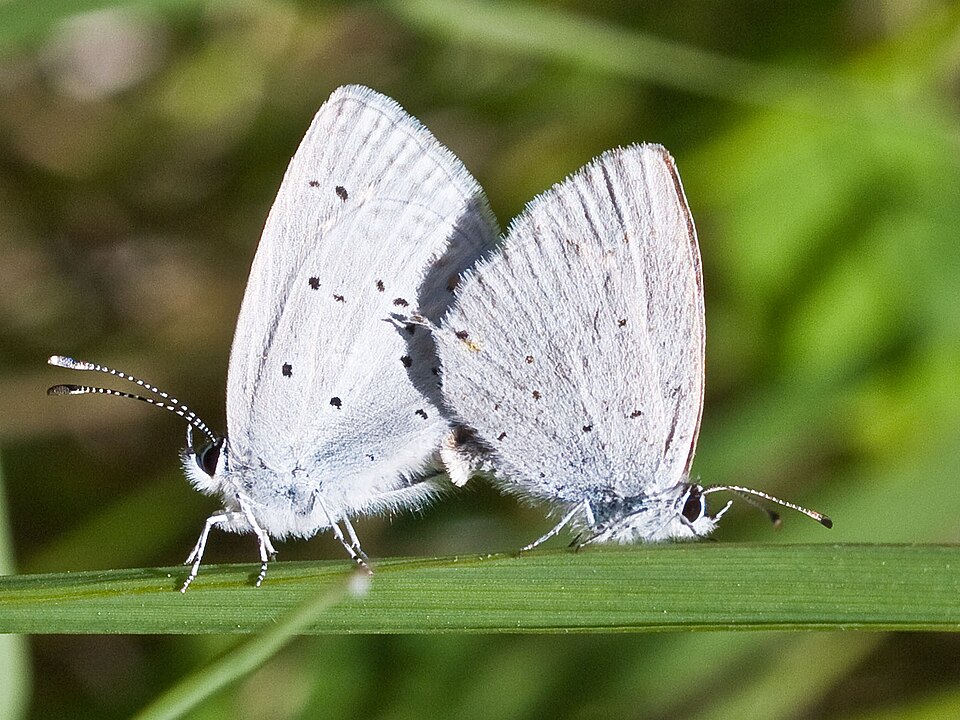

The western tailed-blue (Cupido amyntula) is a Nearctic non-migratory butterfly that commonly takes flight during the spring and summer seasons of March–July. They have a tail on their hindwing, an upper surface that's bluish, and an under surface that is chalky-white with occasional black spots, and an orange spot toward the base of the tail. The wingspan ranges from 0.875 to 1.125 inches (2.2 to 2.9 cm). Larvae feed on various legumes with inflated seed pods, including Astragalus (several species), Lathyrus (several species), Oxytropis, and Vicia (several species). Adults feed on various things such as flower nectar, horse and coyote manure, urine, and mud.
From Wikipedia, under CC BY-SA 4.0.
Is it venomous or poisonous?
We have no record of Western Tailed-blue being toxic, poisonous or venomous. That is not proof that it is safe. Never eat, touch or handle a wild plant, mushroom or animal on the strength of an identification; ask someone qualified.
Easily confused with
Classification
- Kingdom
- Animalia
- Phylum
- Arthropoda
- Class
- Insecta
- Order
- Lepidoptera
- Family
- Lycaenidae
- Genus
- Everes
- Species
- Everes amyntula
Found one? Take a photo and B.inomen will suggest what it is, free.
Check your photo