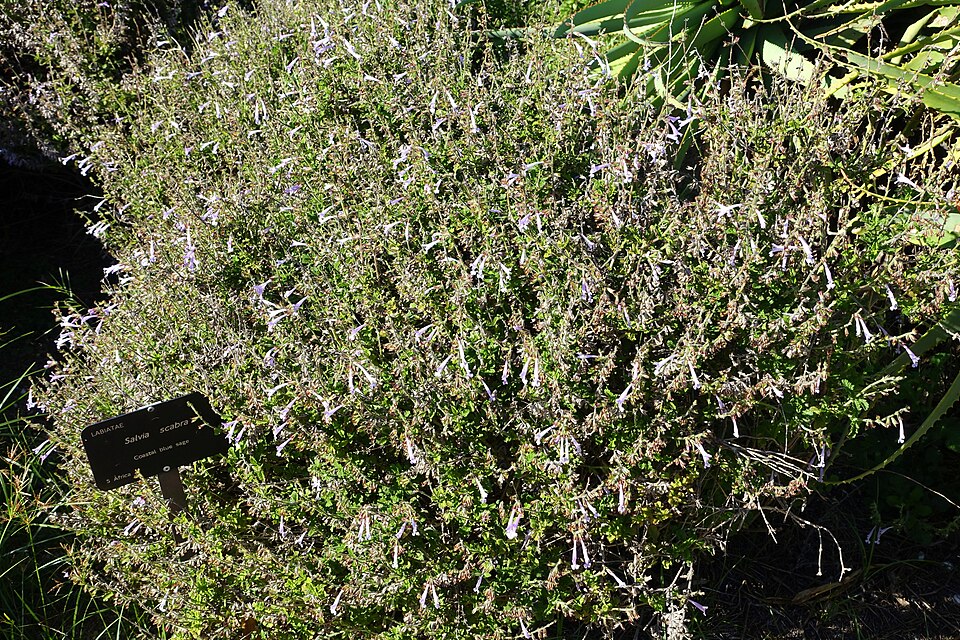

Salvia scabra (coastal blue sage) is a herbaceous perennial native to the southeastern strand of the Cape of Good Hope in South Africa, growing on sandy shores, coastal brush, and hilly slopes up to an elevation of 600 feet. It was described and named by Carl Thunberg in 1800. The leaves and an extract from the roots have been used medicinally in its native region for at least one hundred years. Salvia scabra was introduced to California gardens around 1996 and is extremely adaptable to many types of conditions. Since then, it has spread to gardens in England, France, and Italy.
From Wikipedia, under CC BY-SA 4.0.
Is it poisonous?
We have no record of Coastal Blue Sage being toxic, poisonous or venomous. That is not proof that it is safe. Never eat, touch or handle a wild plant, mushroom or animal on the strength of an identification; ask someone qualified.
Easily confused with
Classification
- Kingdom
- Plantae
- Phylum
- Tracheophyta
- Class
- Magnoliopsida
- Order
- Lamiales
- Family
- Lamiaceae
- Genus
- Salvia
- Species
- Salvia scabra
Found one? Take a photo and B.inomen will suggest what it is, free.
Check your photo