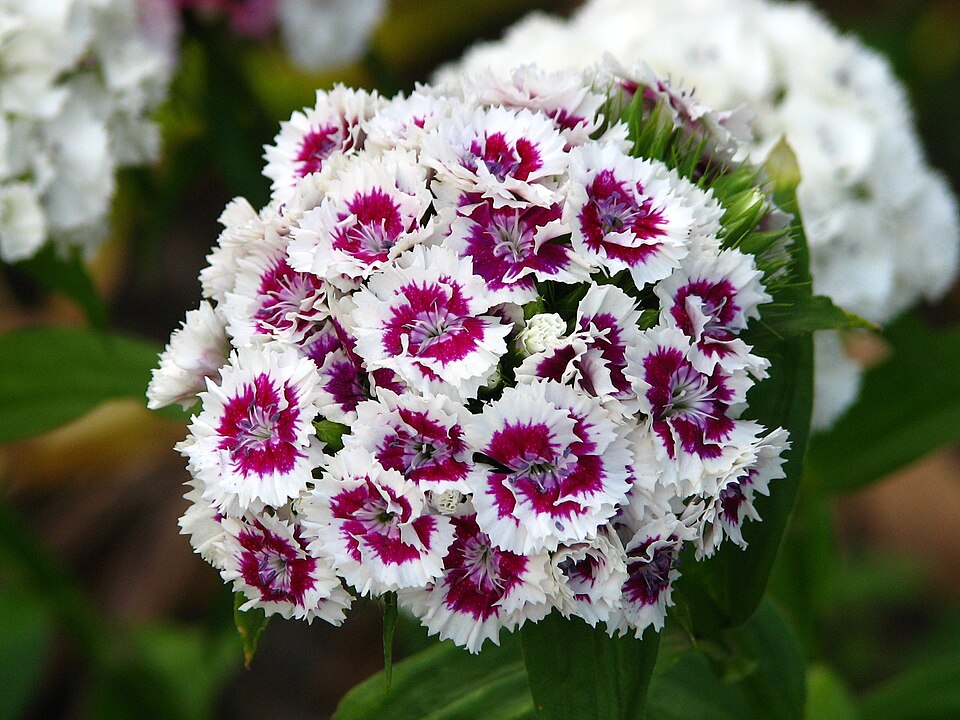

Dianthus barbatus, the sweet William, is a species of flowering plant in the family Caryophyllaceae, native to southern Europe and parts of Asia. It has become a popular ornamental garden plant. It is a herbaceous biennial or short-lived perennial plant growing to 13–92 cm tall, with flowers in a dense cluster of up to 30 at the top of the stems. Each flower is 2–3 cm diameter with five petals displaying serrated edges. Wild plants produce red flowers with a white base, but colours in cultivars range from white, pink, red, and purple to variegated patterns. The exact origin of its English common name is unknown but first appears in 1596 in botanist John Gerard's garden catalogue.
From Wikipedia, under CC BY-SA 4.0.
Is it poisonous?
We have no record of Sweet-William being toxic, poisonous or venomous. That is not proof that it is safe. Never eat, touch or handle a wild plant, mushroom or animal on the strength of an identification; ask someone qualified.
Classification
- Kingdom
- Plantae
- Phylum
- Tracheophyta
- Class
- Magnoliopsida
- Order
- Caryophyllales
- Family
- Caryophyllaceae
- Genus
- Dianthus
- Species
- Dianthus barbatus
Found one? Take a photo and B.inomen will suggest what it is, free.
Check your photo