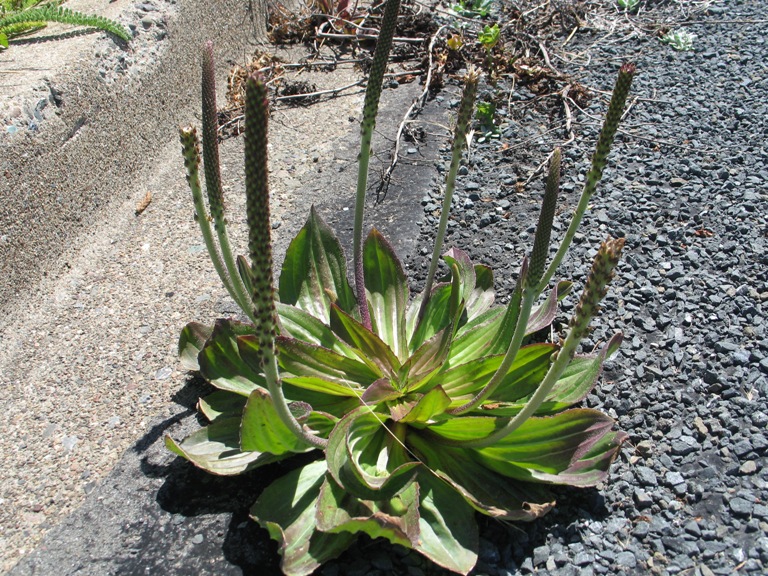

Plantago subnuda is a species of plantain known by the common name tall coastal plantain. It is native to western North America from the west coast of the United States to west-central Mexico, where it grows in wet and moist habitat types, often in coastal areas, such as marshland. It is a perennial herb producing few oval leaves around a thick caudex. The broad smooth-edged or slightly toothed leaves may be up to 40 centimeters (16 in) long. The stemlike inflorescences grow erect to a maximum height near half a meter. Atop the peduncle of the inflorescence is a dense cylindrical spike of many tiny flowers. Each flower has a corolla of ephemeral petals about 3 millimeters long.
From Wikipedia, under CC BY-SA 4.0.
Is it poisonous?
We have no record of Tall Coastal Plantain being toxic, poisonous or venomous. That is not proof that it is safe. Never eat, touch or handle a wild plant, mushroom or animal on the strength of an identification; ask someone qualified.
Easily confused with
Classification
- Kingdom
- Plantae
- Phylum
- Tracheophyta
- Class
- Magnoliopsida
- Order
- Lamiales
- Family
- Plantaginaceae
- Genus
- Plantago
- Species
- Plantago subnuda
Found one? Take a photo and B.inomen will suggest what it is, free.
Check your photo