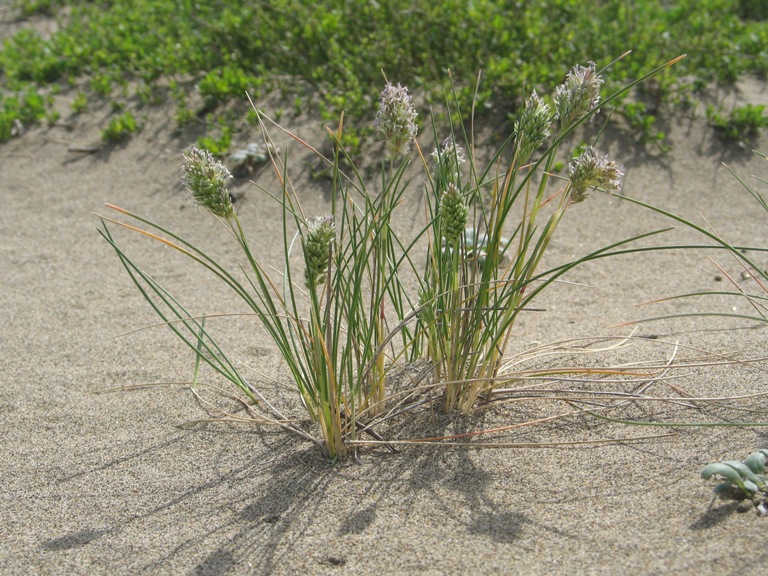

Poa douglasii is a species of grass known by the common names Douglas' bluegrass and sand dune bluegrass. It is endemic to the coastline of California, where it grows in shifting sand dunes. It can be found mostly along the Central Coast and Channel Islands, and occasionally on the North Coast north of Mendocino. It is a perennial grass growing small, dense clumps up to about 30 centimeters in maximum height. It grows from a network of long rhizomes and stolons that anchor the grass to its loose sandy substrate; this network may be up to one meter long. The inflorescence is a dense, oval-shaped series of overlapping spikelets.
From Wikipedia, under CC BY-SA 4.0.
Is it poisonous?
We have no record of Sanddune bluegrass being toxic, poisonous or venomous. That is not proof that it is safe. Never eat, touch or handle a wild plant, mushroom or animal on the strength of an identification; ask someone qualified.
Easily confused with
Classification
- Kingdom
- Plantae
- Phylum
- Tracheophyta
- Class
- Liliopsida
- Order
- Poales
- Family
- Poaceae
- Genus
- Poa
- Species
- Poa douglasii
Found one? Take a photo and B.inomen will suggest what it is, free.
Check your photo