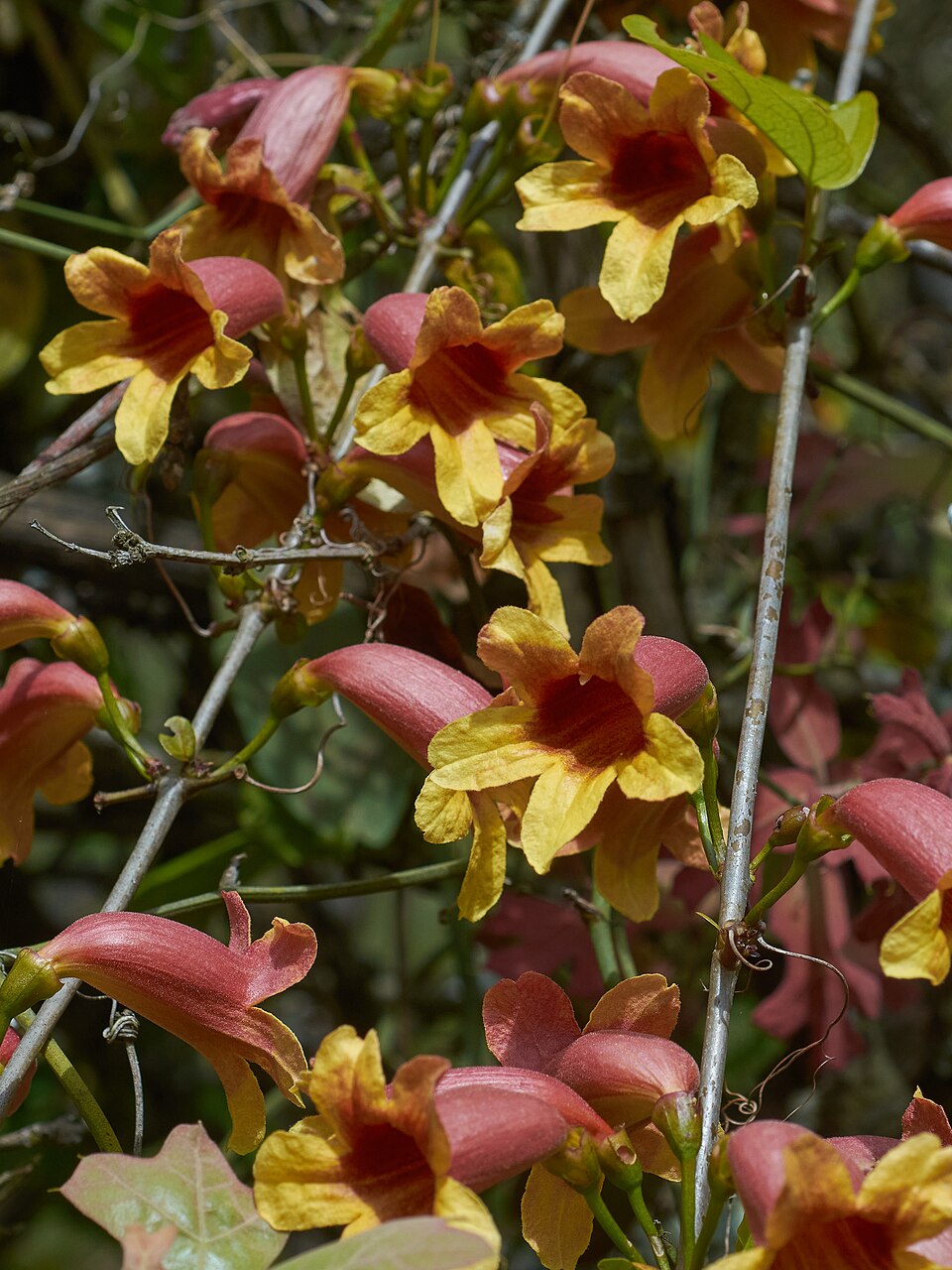

Bignonia capreolata is a vine commonly referred to as crossvine. The common name refers to the cross-shaped pattern revealed when the stem is cut; this pattern results from four radial wedges of phloem embedded within the stem's xylem. It is native to the central and southern United States. The vine climbs without twining but does produce tendrils. It produces long tubular flowers which are red and yellow and frequently have a mocha fragrance. The leaves are dark green to almost purple and produced as opposite pairs with terminal tendrils. The vine often climbs very high, with leaves only remaining on the uppermost portion of the plant.
From Wikipedia, under CC BY-SA 4.0.
Is it poisonous?
We have no record of Cross vine being toxic, poisonous or venomous. That is not proof that it is safe. Never eat, touch or handle a wild plant, mushroom or animal on the strength of an identification; ask someone qualified.
Easily confused with
- Gelsemium sempervirens — considered toxic
Classification
- Kingdom
- Plantae
- Phylum
- Tracheophyta
- Class
- Magnoliopsida
- Order
- Lamiales
- Family
- Bignoniaceae
- Genus
- Bignonia
- Species
- Bignonia capreolata
Found one? Take a photo and B.inomen will suggest what it is, free.
Check your photo