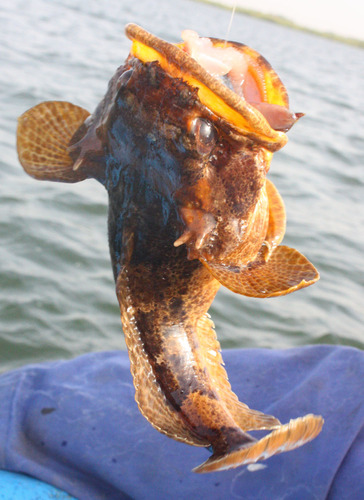
The Lusitanian toadfish (Halobatrachus didactylus) is a species of toadfish found along the Atlantic and Mediterranean Coasts of western Europe and western Africa, from the Bay of Biscay to Ghana, with an isolated and old northern record from the Norwegian side of the Kattegat. This species grows to a length of 50 centimetres (20 in). This species is of minor importance to local commercial fisheries. Locally, it is known as gripau (Catalan), charroco, encharroco, xarroco (Portuguese), and pez sapo (Spanish)).
From Wikipedia, under CC BY-SA 4.0.
Is it venomous or poisonous?
Considered venomous. Public sources list it as such; we have not verified this individually. The note covers its whole family. Never eat, touch or handle a wild plant, mushroom or animal on the strength of an identification; ask someone qualified.
Easily confused with
- Opsanus tau — considered venomous
- Opsanus beta — considered venomous
- Aphos porosus — considered venomous
- Porichthys porosissimus — considered venomous
- Kathetostoma laeve
- Lophius americanus
Classification
- Kingdom
- Animalia
- Phylum
- Chordata
- Class
- Actinopterygii
- Order
- Batrachoidiformes
- Family
- Batrachoididae
- Genus
- Halobatrachus
- Species
- Halobatrachus didactylus
Found one? Take a photo and B.inomen will suggest what it is, free.
Check your photo