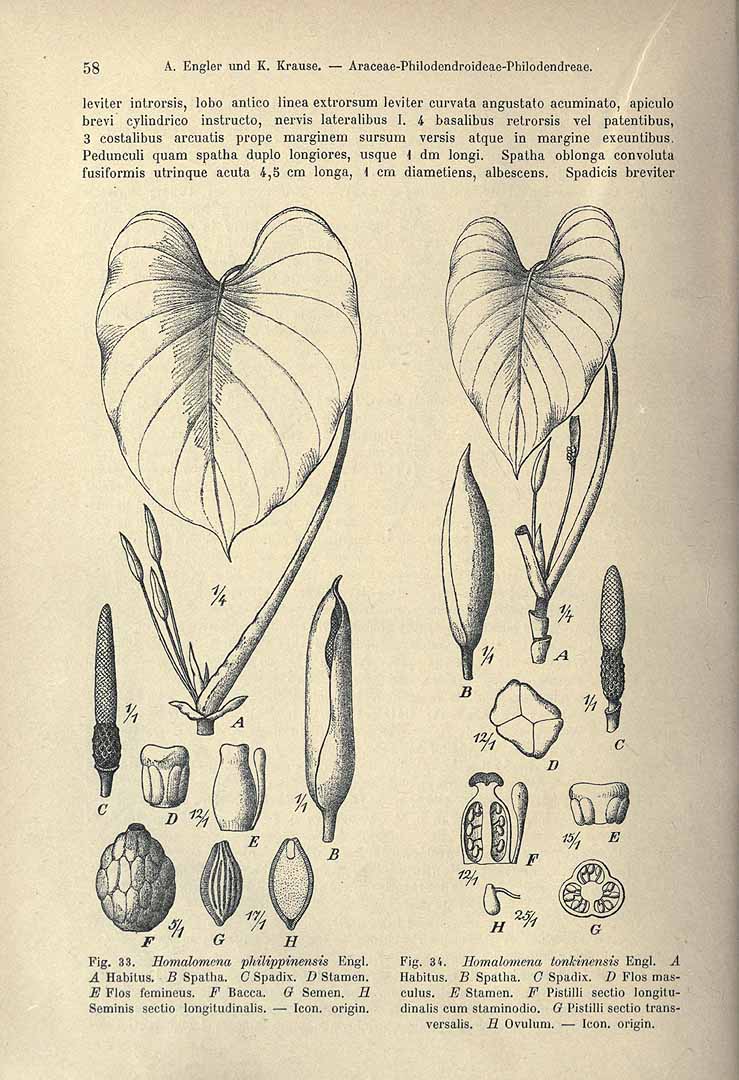

Homalomena philippinensis is a species of flowering plants in the family Araceae. It is native to the Philippines and Orchid Island in Taiwan. The plant has large heart-shaped leaves that grow up to around 1 m (3.3 ft) tall from an underground corm. It grows at low elevations usually in forests and along bodies of water. It is commonly known as payau or payaw, alupayi or alopayi, salet, or tahig, among other names.
From Wikipedia, under CC BY-SA 4.0.
Is it poisonous?
We have no record of Homalomena philippinensis being toxic, poisonous or venomous. That is not proof that it is safe. Never eat, touch or handle a wild plant, mushroom or animal on the strength of an identification; ask someone qualified.
Easily confused with
- Schismatoglottis kotoensis
- Philodendron eximium
- Philodendron pastazanum
- Philodendron giganteum
- Philodendron thalassicum
- Philodendron grandipes
Classification
- Kingdom
- Plantae
- Phylum
- Tracheophyta
- Class
- Liliopsida
- Order
- Alismatales
- Family
- Araceae
- Genus
- Homalomena
- Species
- Homalomena philippinensis
Found one? Take a photo and B.inomen will suggest what it is, free.
Check your photo