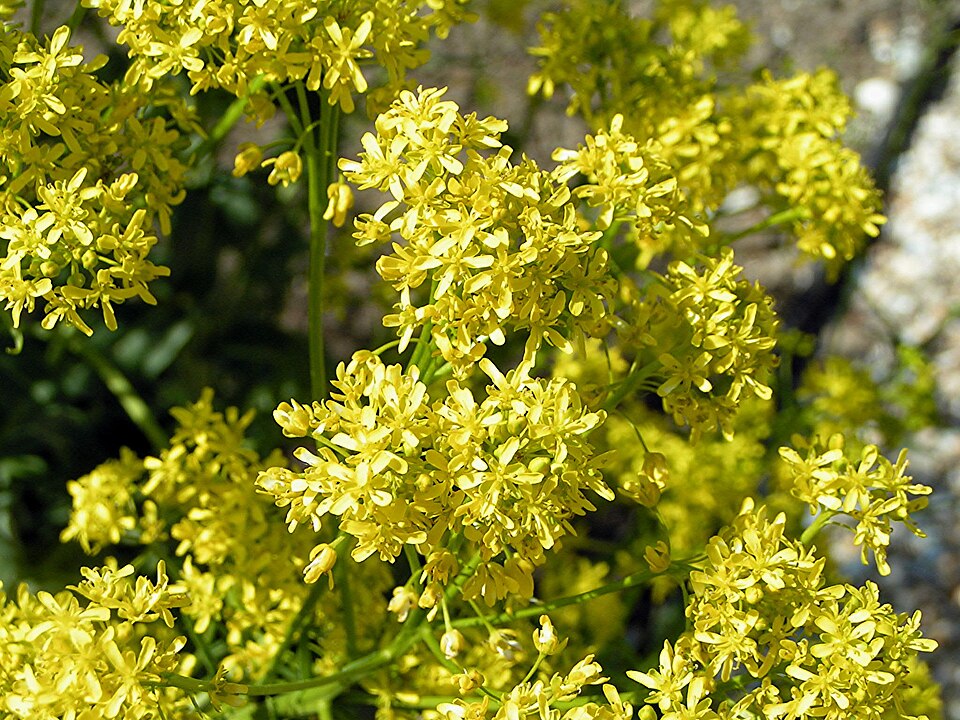

Isatis tinctoria, also called woad (), dyer's woad, dyer's-weed, or glastum, is a flowering plant in the family Brassicaceae (the mustard family) with a documented history of use as a blue dye and medicinal plant. The double use of woad is seen in its name: the term Isatis is linked to its ancient use to treat wounds; the term tinctoria references its use as a dye. It is occasionally known as Asp of Jerusalem. Woad is also the name of a blue dye produced from the leaves of the plant. Woad is native to the steppe and desert zones of the Caucasus, Central Asia to Eastern Siberia and Western Asia but is now also found in South-Eastern and Central Europe and western North America.
From Wikipedia, under CC BY-SA 4.0.
Is it poisonous?
We have no record of Woad being toxic, poisonous or venomous. That is not proof that it is safe. Never eat, touch or handle a wild plant, mushroom or animal on the strength of an identification; ask someone qualified.
Easily confused with
Classification
- Kingdom
- Plantae
- Phylum
- Tracheophyta
- Class
- Magnoliopsida
- Order
- Brassicales
- Family
- Brassicaceae
- Genus
- Isatis
- Species
- Isatis tinctoria
Found one? Take a photo and B.inomen will suggest what it is, free.
Check your photo