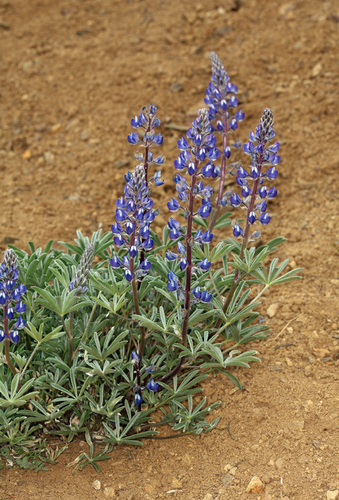
Lupinus nevadensis is a species of lupine known by the common name Nevada lupine. It is native to the western Great Basin in Nevada and adjacent sections of Oregon and California, where it grows in sagebrush and other typical basin habitat. It is an erect perennial herb growing 10 to 40 centimeters tall. Each palmate leaf is made up of 6 to 10 hairy leaflets up to 5 centimeters long. The stem and herbage are coated in long hairs. The inflorescence is a spiral of flowers each around 1 centimeter in length. The flower is blue with a whitish patch on its banner and a curved keel. The fruit is a very hairy legume pod up to 4 centimeters long.
From Wikipedia, under CC BY-SA 4.0.
Is it poisonous?
Considered toxic. Public sources list it as such; we have not verified this individually. The note covers its whole genus. Quinolizidine alkaloids in seeds of many species Never eat, touch or handle a wild plant, mushroom or animal on the strength of an identification; ask someone qualified.
Easily confused with
- Lupinus saxosus — considered toxic
- Lupinus caudatus — considered toxic
- Lupinus sericeus — considered toxic
- Lupinus argenteus — considered toxic
- Lupinus meionanthus — considered toxic
- Lupinus ammophilus — considered toxic
Classification
- Kingdom
- Plantae
- Phylum
- Tracheophyta
- Class
- Magnoliopsida
- Order
- Fabales
- Family
- Fabaceae
- Genus
- Lupinus
- Species
- Lupinus nevadensis
Found one? Take a photo and B.inomen will suggest what it is, free.
Check your photo