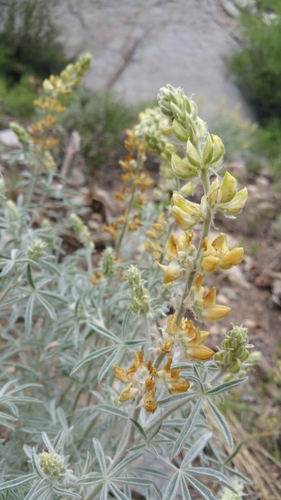
Lupinus padre-crowleyi is a rare species of lupine known by the common names Father Crowley's lupine and DeDecker's lupine. It is endemic to California, where it is known only from the eastern slopes of the Sierra Nevada and the high plateau below along the western border of Inyo County. It grows in the granite soils of the mountain forests and scrub. It has been noted at fewer than 20 locations. This is a perennial herb growing an erect inflorescence from a mat of silvery, woolly-haired herbage, reaching maximum heights over half a meter. Each palmate leaf is made up of 6 to 9 leaflets up to 7.5 centimeters long.
From Wikipedia, under CC BY-SA 4.0.
Is it poisonous?
Considered toxic. Public sources list it as such; we have not verified this individually. The note covers its whole genus. Quinolizidine alkaloids in seeds of many species Never eat, touch or handle a wild plant, mushroom or animal on the strength of an identification; ask someone qualified.
Easily confused with
- Lupinus elatus — considered toxic
- Lupinus leucophyllus — considered toxic
- Lupinus meionanthus — considered toxic
Classification
- Kingdom
- Plantae
- Phylum
- Tracheophyta
- Class
- Magnoliopsida
- Order
- Fabales
- Family
- Fabaceae
- Genus
- Lupinus
- Species
- Lupinus padre-crowleyi
Found one? Take a photo and B.inomen will suggest what it is, free.
Check your photo