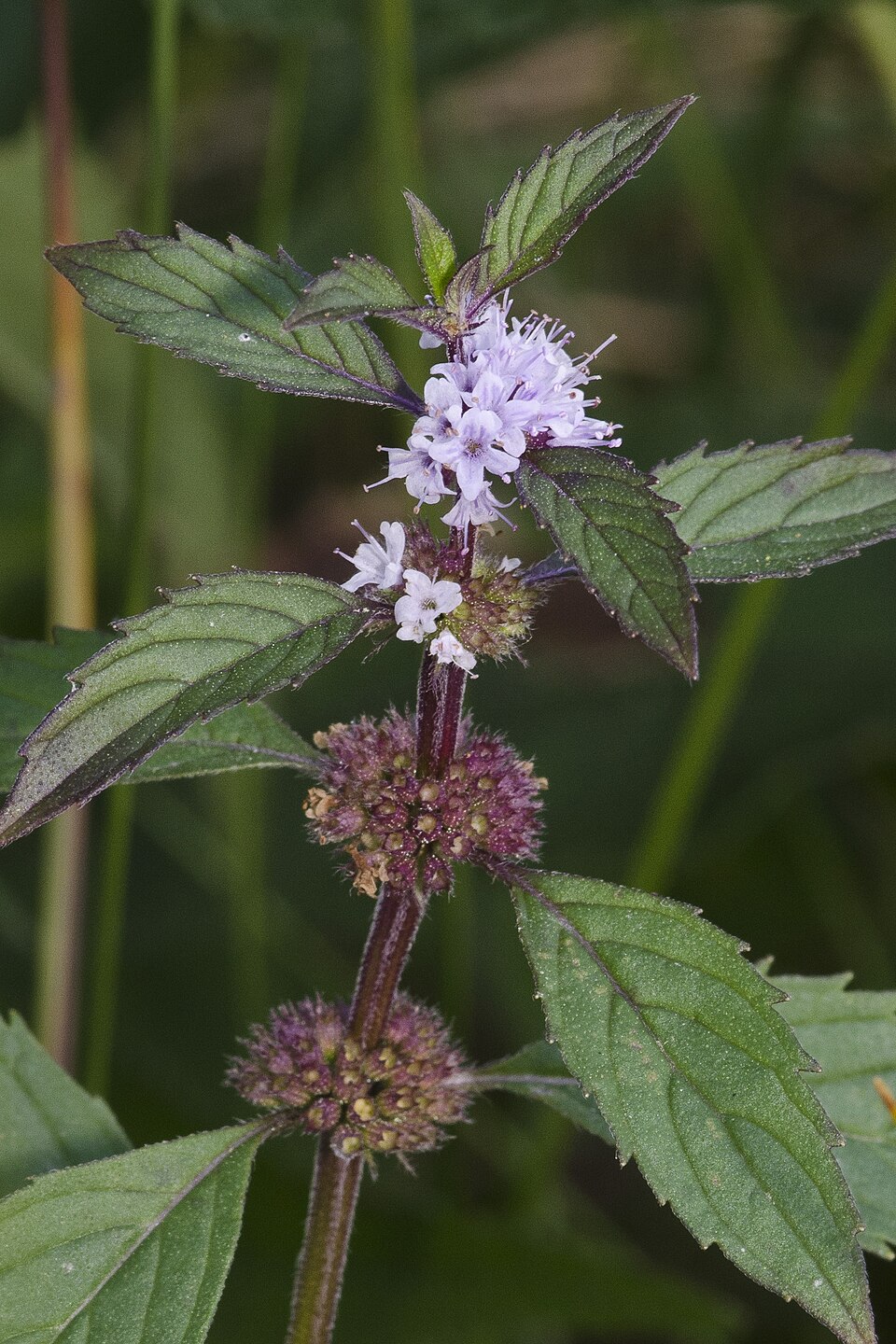

Mentha canadensis is a species of mint native to North America (from the Northwest Territories to central Mexico) and the eastern part of Asia (from Siberia to Java). In North America, it is commonly known as Canada mint, American wild mint, and in Asia as Chinese mint, Sakhalin mint, Japanese mint, and East Asian wild mint. The flowers are bluish or have a slight violet tint. The plant is upright, growing to about 30–60 cm (12–24 in) tall. The leaves are opposite, and flower clusters appear in the upper leaf axils. This mint grows in wet areas but not directly in water, so it will be found near marshes, and lake and river edges. Plants bloom from July to August in their native habitats.
From Wikipedia, under CC BY-SA 4.0.
Is it poisonous?
We have no record of Canada mint being toxic, poisonous or venomous. That is not proof that it is safe. Never eat, touch or handle a wild plant, mushroom or animal on the strength of an identification; ask someone qualified.
Easily confused with
Classification
- Kingdom
- Plantae
- Phylum
- Tracheophyta
- Class
- Magnoliopsida
- Order
- Lamiales
- Family
- Lamiaceae
- Genus
- Mentha
- Species
- Mentha canadensis
Found one? Take a photo and B.inomen will suggest what it is, free.
Check your photo