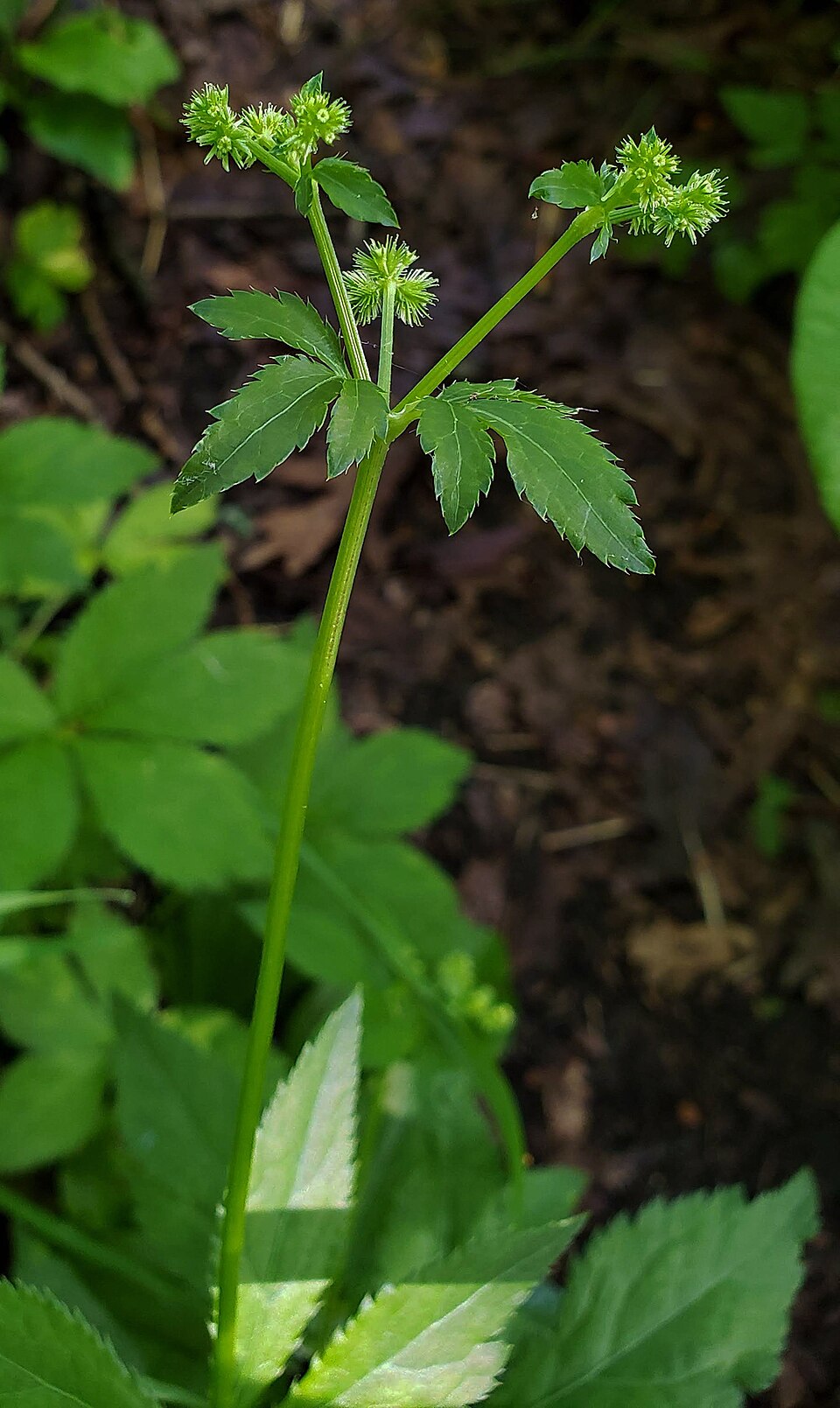

Sanicula canadensis, the Canadian blacksnakeroot, is a native plant of North America and a member of family Apiaceae. It is biennial or perennial, and spreads primarily by seed. It grows from 1 to 4.5 feet tall, and is found in mesic deciduous woodlands. The whitish-green flowers with sepals longer than petals, appearing late spring or early summer and lasting for approximately three weeks, are green and bur-like. The bur-like fruit each split into 2 seeds. The species ranges throughout the eastern United States (excluding Maine), extending north into Quebec and Ontario, and west into Texas and Wyoming.
From Wikipedia, under CC BY-SA 4.0.
Is it poisonous?
We have no record of Black Snakeroot being toxic, poisonous or venomous. That is not proof that it is safe. Never eat, touch or handle a wild plant, mushroom or animal on the strength of an identification; ask someone qualified.
Easily confused with
- Sanicula smallii
- Sanicula odorata
- Sanicula trifoliata
- Sanicula chinensis
- Sanicula liberta
- Sanicula marilandica
Classification
- Kingdom
- Plantae
- Phylum
- Tracheophyta
- Class
- Magnoliopsida
- Order
- Apiales
- Family
- Apiaceae
- Genus
- Sanicula
- Species
- Sanicula canadensis
Found one? Take a photo and B.inomen will suggest what it is, free.
Check your photo