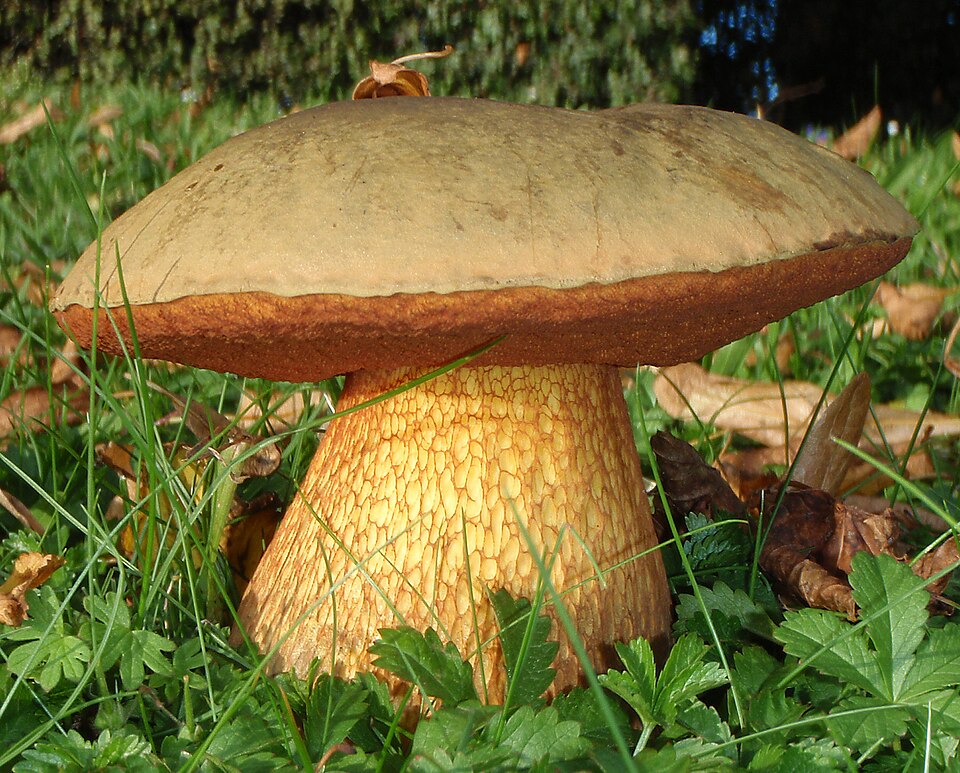

Suillellus luridus (formerly Boletus luridus), commonly known as the lurid bolete, is a fungus of the family Boletaceae, found in calcareous broadleaved woodlands in Europe. Fruit bodies appear in summer and autumn and may be locally abundant. It is a firm bolete with an olive-brown cap up to 20 cm (8 in) in diameter, with small orange or red pores on the underside (yellow when young). The stout ochre stem reaches 8–14 cm (3–6 in) high and 1–3 cm (0.4–1.2 in) wide, and is patterned with a red network. Like several other red-pored boletes, it stains blue when bruised or cut.
From Wikipedia, under CC BY-SA 4.0.
Is it poisonous?
We have no record of Lurid Bolete being toxic, poisonous or venomous. That is not proof that it is safe. Never eat, touch or handle a wild plant, mushroom or animal on the strength of an identification; ask someone qualified.
Easily confused with
Classification
- Kingdom
- Fungi
- Phylum
- Basidiomycota
- Class
- Agaricomycetes
- Order
- Boletales
- Family
- Boletaceae
- Genus
- Suillellus
- Species
- Suillellus luridus
Found one? Take a photo and B.inomen will suggest what it is, free.
Check your photo