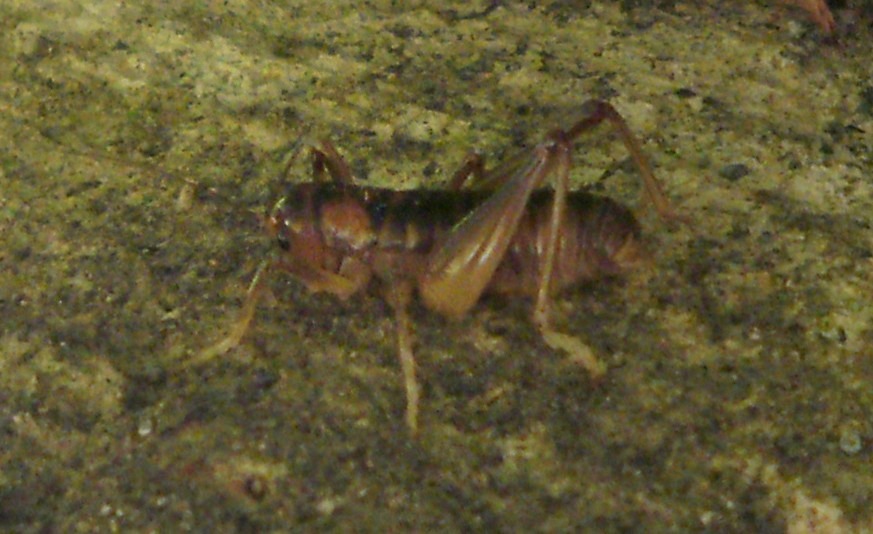

Hemiandrus pallitarsis is a species of ground weta endemic to New Zealand. This nocturnal species hides in burrows during the day, and can be an important food for kiwi. They can be identified by a single foretibial spine, three prolateral spines, and four retrolateral spines on the mesotibia, and their tibia lacks a tympanal membrane (they hear only through vibrations in the ground). The female has an unusual appendage on her abdomen, and the male has blackened hooks on his last tergite. They have a two-year life cycle, and their diet is largely unknown. Unusually for an insect, the female shows maternal care towards her eggs and nymphs.
From Wikipedia, under CC BY-SA 4.0.
Is it venomous or poisonous?
We have no record of Hemiandrus pallitarsis being toxic, poisonous or venomous. That is not proof that it is safe. Never eat, touch or handle a wild plant, mushroom or animal on the strength of an identification; ask someone qualified.
Easily confused with
- Hemiandrus maia
- Hemiandrus celaeno
- Anderus maculifrons
- Nippancistroger testaceus
- Apotetamenus clipeatus
- Ceuthophilus californianus
Classification
- Kingdom
- Animalia
- Phylum
- Arthropoda
- Class
- Insecta
- Order
- Orthoptera
- Family
- Anostostomatidae
- Genus
- Hemiandrus
- Species
- Hemiandrus pallitarsis
Found one? Take a photo and B.inomen will suggest what it is, free.
Check your photo