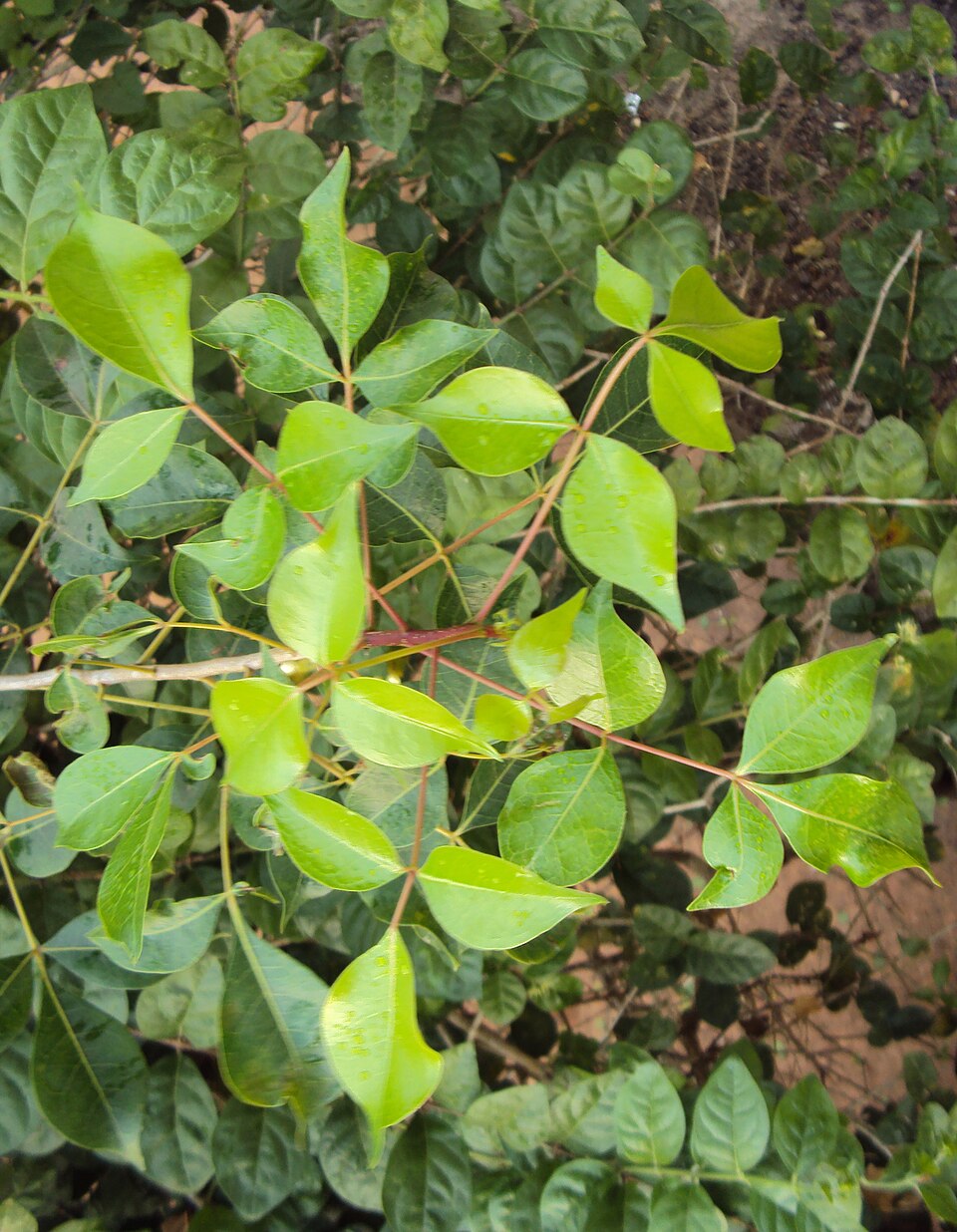

Commiphora caudata, the hill mango or green commiphora, is the most abundant Asian species of the genus Commiphora of flowering plants in the family Burseraceae. It is native to Southern India and Sri Lanka, usually growing in the full sun on hilly granite rock outcrops in dry zone areas. It is a small to medium-sized deciduous tree which may reach a height of 10-20m, but usually less. The tree has a smooth, succulent green bark, which partly flakes off with age, giving rise to a characteristic patchwork of green and brown patches. Its sap has a strong resinous scent. The tree has medicinal properties.
From Wikipedia, under CC BY-SA 4.0.
Is it poisonous?
We have no record of Commiphora caudata being toxic, poisonous or venomous. That is not proof that it is safe. Never eat, touch or handle a wild plant, mushroom or animal on the strength of an identification; ask someone qualified.
Easily confused with
- Bursera grandifolia
- Commiphora leptophloeos
- Bursera simaruba
- Lannea schweinfurthii
- Bursera lancifolia
- Commiphora harveyi
Classification
- Kingdom
- Plantae
- Phylum
- Tracheophyta
- Class
- Magnoliopsida
- Order
- Sapindales
- Family
- Burseraceae
- Genus
- Commiphora
- Species
- Commiphora caudata
Found one? Take a photo and B.inomen will suggest what it is, free.
Check your photo