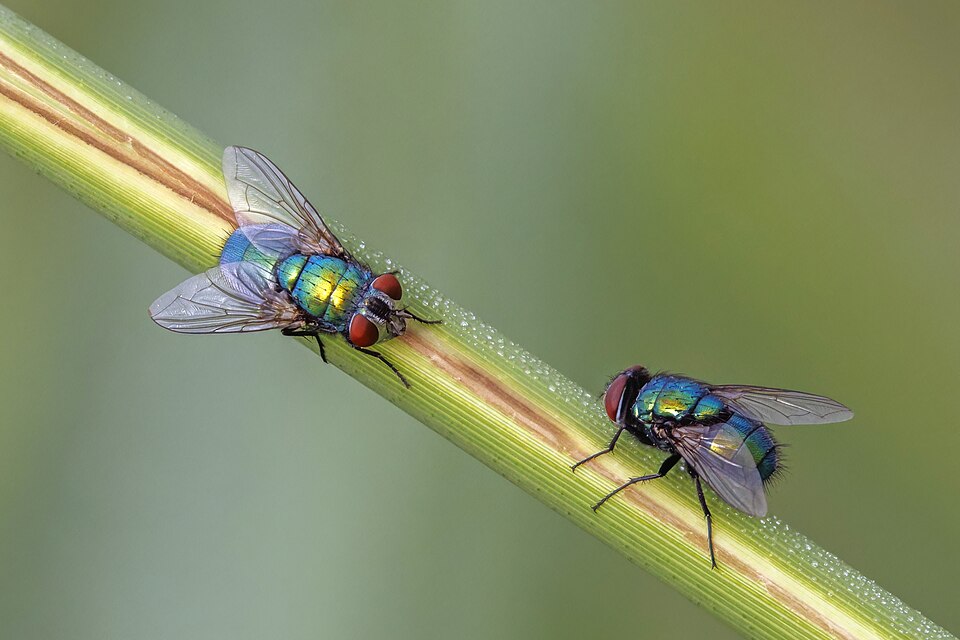

The common green bottle fly or common European green bottle fly (Lucilia sericata) is a blowfly found in most areas of the world and is the most well-known of the numerous green bottle fly species. Its body is 10–14 mm (0.39–0.55 in) in length – slightly larger than a house fly – and has brilliant, metallic, blue-green or golden coloration with black markings. It has short, sparse, black bristles (setae) and three cross-grooves on the thorax. The wings are clear with light brown veins, and the legs and antennae are black. The larvae of the fly may be used for maggot therapy, are commonly used in forensic entomology, and can be the cause of myiasis in livestock and pets.
From Wikipedia, under CC BY-SA 4.0.
Is it venomous or poisonous?
We have no record of Common European Greenbottle Fly being toxic, poisonous or venomous. That is not proof that it is safe. Never eat, touch or handle a wild plant, mushroom or animal on the strength of an identification; ask someone qualified.
Easily confused with
Classification
- Kingdom
- Animalia
- Phylum
- Arthropoda
- Class
- Insecta
- Order
- Diptera
- Family
- Calliphoridae
- Genus
- Lucilia
- Species
- Lucilia sericata
Found one? Take a photo and B.inomen will suggest what it is, free.
Check your photo